

South African nonprofits continue to face severe funding pressures, but funding alone cannot ensure long-term sustainability.
In May 2026, Trialogue and the Ford Foundation hosted a conversation on building a more resilient civil society. Although funding remains paramount, strong governance, capable leadership, effective decision-making and organisational capacity are equally important in helping nonprofits navigate complex challenges and deliver sustainable impact.
In September 2026, Trialogue and the FirstRand Foundation took the conversation further by exploring how companies can build these capabilities through purposeful partnerships.
The panellists were Dean Peters (Solutions Specialist, Retail & Business Banking and FRV CEO Accelerator Team Lead at FNB), Sonja Cilliers (Head of PGDip in Business Management and Administration at Stellenbosch University Business School), Bokang Mokoena (Founder and Executive Director, Phakamani Young Minds Academy (PYMA)) and Lucas Gusengwe (Youth Programme Coordinator at PYMA).
The support nonprofits need most
Funding remains the most urgent concern for many nonprofits. A snap poll conducted during the webinar found that 58% of attendees identified fundraising and sustainability as the sector’s most pressing capacity-building needs. This aligns with findings from the 2025 edition of the Trialogue Business in Society Handbook, which found that 68% of participating nonprofits had less than six months of reserves, or no reserves at all.

However, the discussion revealed that the sector’s needs extend beyond financial resources. A follow-up poll found that network and partnership development was the most valued form of support after funding (37%), followed by fundraising support (27%) and technology and systems support (13%).
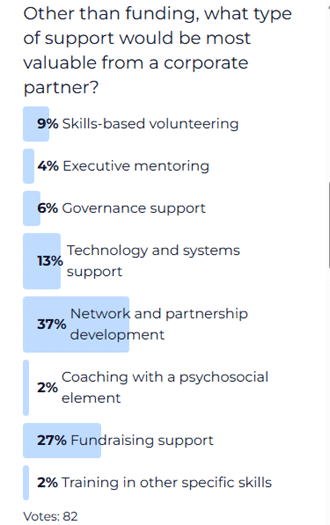
Most corporate social investment (CSI) programmes focus on funding.
“Although that’s essential, we increasingly recognise that sustainable impact depends on financial support, strong leadership, sound governance, effective decision-making and organisational capacity,” said Peters. The FirstRand CEO Volunteer Accelerator Programme was designed to help nonprofits build the leadership, governance and operational capabilities they need to remain sustainable in the long run.
Building better nonprofit boards
The webinar explored the FirstRand Foundation’s capacity building in practice, one element of which is the NPO Governance Programme, developed by Stellenbosch Business School and accredited by the Institute of Directors South Africa (IoDSA). It was designed to build a pipeline of capable trustees and directors in the nonprofit sector.
“Many trustees understand fiduciary duty as legal or administrative compliance rather than values-based practice,” said Cilliers. “Good intentions on a board are not enough if the trustees don’t have the tools to hold management accountable.”
Following a three-year pilot with FirstRand partners, the programme will open to the broader nonprofit sector in 2027, with two cohorts of around 16 participants each planned for May and August. It focuses on the core roles nonprofit board members need to fulfil: fiduciary oversight, board effectiveness, ethics, financial stewardship and stakeholder communication. The curriculum is grounded in the King V Code of Corporate Governance and the IoDSA competency framework.
Cilliers says the classroom simulates real boardroom dynamics, and learning is reinforced through practical exercises and assignments. The programme concludes with a summative assessment in which participants critically evaluate a board they serve on. Participant satisfaction to date has been high. “More than 90% of participants reported being very satisfied with the knowledge gained, while more than 90% said the skills acquired could be directly applied in their work,” Cilliers pointed out.
The course targets current and aspiring trustees and directors, though it broadly supports leadership capacity within the nonprofit sector. Registrations will open early next year, with programme fees to be finalised.
Partnerships in practice: the PYMA experience
One organisation that has benefited from the CEO Volunteer Accelerator Programme and the NPO Governance Programme is PYMA, a youth-led nonprofit founded in Johannesburg in 2014. PYMA helps young people progress from education into further study, employment and leadership opportunities and also supports 74 ECD centres across Gauteng.
Mentorship and coaching allowed PYMA to go on a journey with FirstRand employees, rather than be handed a ready-made solution. “Nonprofits have often been dictated to, but the power was given back to us so we could work collectively,” said Mokoena. The starting point was listening, said Peters, to understand context and needs. The next step was to understand where FirstRand and FNB skills could be used.
In PYMA’s case, this included the creation of a cloud-based platform that allows its programmes to be delivered to learners digitally. The iterative process involved moving from idea to prototype, identifying challenges, solving problems and testing before piloting.
Mokoena said working with strategic partners like FirstRand allows organisations like PYMA to achieve greater impact with a more strategic approach. “You don’t have to chase every partner – you have to ask yourself what you want to achieve and which elements of your strategy you can work on collectively,” he explained.
For Gusengewe, participating in the CEO Volunteer Accelerator Programme had an immediate, personal benefit. After joining PYMA as a programme participant in 2023, he secured a permanent role with the organisation in 2025 and now serves as Youth Programme Coordinator, overseeing the programmes he once attended.
“I was looking for an opportunity, and now I’m at the forefront of creating one,” he said. For him, leadership is not just about holding a position but creating an opportunity for other people to grow – and the 600 young people on PYMA’s database can benefit from the opportunities he himself has been given. “Sometimes giving back isn’t about doing something extraordinary – it can just be about helping someone to complete an application form, or mentoring them,” he noted. He added that a lack of confidence, rather than a lack of potential and skills, held him back: “You can only conquer in this world if you believe in yourself.”
While each programme has a defined timeline, Peters said the relationship between organisations does not come to an end. FirstRand Foundation’s aim is to create lasting benefits that resonate beyond programme delivery. This can include financial resilience, scaled impact, and community improvements.
A final poll saw webinar attendees identify the most important factor in a successful partnership, with long-term commitment the most critical (30%).
Building partnerships that last
Asked to share one practical recommendation for building stronger partnerships and organisational capacity, the panellists agreed that sustainable impact depends on more than funding.
Peters said strong partnerships start with listening and recognising the different strengths each partner brings. “Funding creates the impact, but capability sustains it at the end of the day.”
Cilliers stressed the importance of investing in governance. “Funding a programme is necessary, but it’s not sufficient if the board delivering that programme doesn’t have the financial literacy, risk awareness and ethical confidence to steward it well,” she said. She argued that the most valuable support is often “structured, sustained capacity building” that remains long after a grant ends.
Mokoena encouraged nonprofits to invest in monitoring and evaluation. “It holds the knowledge and insights of what’s working on the ground,” and helps organisations influence funders on where interventions are needed, creating opportunities for genuine co-creation.
Gusengwe highlighted the power of collaboration, noting that partnering with both companies and other nonprofits can multiply impact and better meet the needs of young people.
Watch the full webinar
for additional insights.
- Register your nonprofit organisation on FirstRand Foundation’s online grant application and registration platform to be considered for funding or support opportunities.
- Register your interest in more information about the Stellenbosch University NPO Governance Programme: https://stellenboschbusiness.idloom.events/NPO-Governance-Programme-Expression-of-Interest/register.
- Read more about capacity building in the nonprofit sector.
- Watch the webinar ‘Building a more resilient civil society’, presented by Trialogue in partnership with the Ford Foundation in May 2026.
