DEVELOPMENT TOPICS: Safety and security

Investing in safety and security in Africa helps to safeguard lives and property, maintain stability, and preserve social cohesion.
These are important factors, since an unstable environment threatens business itself. It also makes sense to protect employees and customers from crime and violence, which can lead to injury or death, damage to property, and financial loss.
Africa faces several challenges in safety and security.
On a macro level, these include war and displacement, terrorism and violent extremism, political instability, and leaders refusing to give up political office. The African continent is the site of more coups than anywhere else in the world, and most Africans have experienced deteriorations in safety and security over the past decade, with overall governance improvements stalling.
Violence against civilians and armed conflicts are more severe now than they were a decade ago. Protests have become more common, along with complaints of police brutality. Further challenges on the continent include crime, inadequate policing that leads to vigilantism, and mistrust of security and justice institutions.
To improve safety and security, companies can invest in:
- Strengthening community-level crime prevention and violence reduction initiatives
- Supporting policing capacity and justice-sector improvements
- Investing in technology, infrastructure and data systems that enhance public safety
- Building resilience and social cohesion in communities experiencing instability
Discover how your company can drive meaningful impact and support safety and security initiatives.
National context
- The peace and security budget increased from R244 billion in 2024/25 to R266 billion in 2025/26, constituting 10.3% of consolidated government expenditure of R2.59 trillion for the year. Of this, police services received R125 billion, law courts and prisons R54 billion, defence and state security R53 billion and home affairs R11 billion.
- The South African Police Service’s (SAPS) crime statistics for the 2024/25 financial year showed a slight decrease in contact crimes from the previous year to about 670 000 incidents, including 27 061 murders and 53 061 sexual offences.
- The SAPS and government hosted the first National Policing Summit over three days in April 2025. The summit brought together government officials, police leadership, academics and community members to discuss service delivery, the evolving policing landscape, harnessing the power of technology and strengthening the SAPS workforce. The summit ended with an agreement to establish a National Policing Summit Operations Room to track the progress of summit resolutions over the next five years.
- The Special Investigating Unit (SIU) and Asset Forfeiture Unit report that over R10 billion has been recovered in state capture-related cases since the SIU investigations began in 2018, up to March 2025.
- Government will finalise the Whistleblower Protection Framework and introduce the Whistleblower Protections Bill in Parliament before the end of this financial year in February 2026. In 2025, the police and government took significant steps to arrest people linked to the looting of state funds from Tembisa Hospital. Babita Deokaran, who worked in the Gauteng Health Department, was killed in 2021 after blowing the whistle on corruption worth billions at Tembisa Hospital.
- South Africa was ranked 124 out of 163 countries in the Institute for Economics and Peace’s Global Peace Index 2025, moving up three places from its 2024 ranking. The 2025 index found that the world became less peaceful for the 13th time in the past 17 years, with the average level of country peacefulness deteriorating by almost 0.4% over the prior year. This marks the sixth consecutive year that peacefulness has declined.
- The global Financial Action Task Force (FATF) greylisted South Africa in February 2023, subjecting it to additional oversight due to eight areas of deficiencies in tackling money laundering and illicit financial flows. As of June 2025, the country had completed all 22 action items, and an FATF on-site visit was held in July 2025. On 24 October 2025, the FATF announced South Africa’s removal from the list of jurisdictions under increased monitoring after the country completed its action plan.
- Government’s budget for education, learning and culture in 2025/26 is R508 billion, up from R482 billion in 2024/25. This represents 20% of the consolidated national government expenditure bill of R2.59 trillion. Of this, R332 billion (65%) is allocated to basic education, R48 billion to higher education, R14 billion to technical and vocational education and training and R55 billion to the National Student Financial Aid Scheme.
- President Cyril Ramaphosa signed the Basic Education Laws Amendment Bill into law in September 2024. In February 2025, Minister of Basic Education Siviwe Gwarube told Parliament the Act was fully operational. The Act aims to strengthen governance in South Africa’s education sector.
- During his 2025 State of the Nation Address, Ramaphosa announced that the government was implementing Phase 1 of the Comprehensive Student Funding Model for Higher Education to address the needs of the ‘missing middle’. An additional 10 000 students were expected to be assisted by the end of the first year in 2025. In 2024, over 900 000 students from poor and working-class backgrounds received funding to study at universities and colleges.
- According to Gwarube, 724 156 out of 1.2 million learners who started Grade 1 in 2013 enrolled as full-time candidates for matric in 2024 (approximately 59%), indicating a high dropout rate and a high rate of learners who did not complete their basic education in 12 years. Of the 705 291 full-time candidates who wrote the 2024 exams, just over 87% passed, an increase of more than four percentage points from 82% in 2023.
- The pit latrines in over 93% of the 3 372 schools identified with them were replaced under the Sanitation Appropriate for Education (SAFE) initiative by March 2025. According to the Department of Basic Education (DBE), infrastructure backlogs remain: 13 655 schools need more toilets, 6 319 lack sustainable water and 8 265 need more classrooms. The DBE estimates that R129 billion will be required to address infrastructure backlogs by 2030.
- Phase 5 of the Basic Education Employment Initiative (BEEI) was launched in June 2025, creating 204 676 job opportunities for youth aged 18–34. Roles include education assistants, general school assistants, ICT eCadres, reading champions and infrastructure handypersons. This phase is funded by R4 billion from the Unemployment Insurance Fund (UIF) and R1.6 billion from the National Treasury.
- The Thrive by Five Index 2024 found that only 42% of preschoolers are developmentally on track (see page 239 for more on the Index). The rand value of the early childhood development (ECD) subsidy increased for the first time since 2019, from R17 to R24 per child per day, which ECD systems change nonprofit Ilifa Labantwana estimates covers 66% of the total cost of providing quality early learning programme services.
- Education fees are surveyed annually in March, according to Statistics South Africa (Stats SA). The education price index increased by 4.5% in 2025, below the 6.4% rise in 2024. School fees increased by 5.0% (from 6.6% in 2024). Tertiary education institutions charged 3.7% more in 2025, down from 5.9% in 2024.
Overview of CSI spend
Safety and security initiatives were supported by 24% of companies and received 1% of average CSI expenditure.
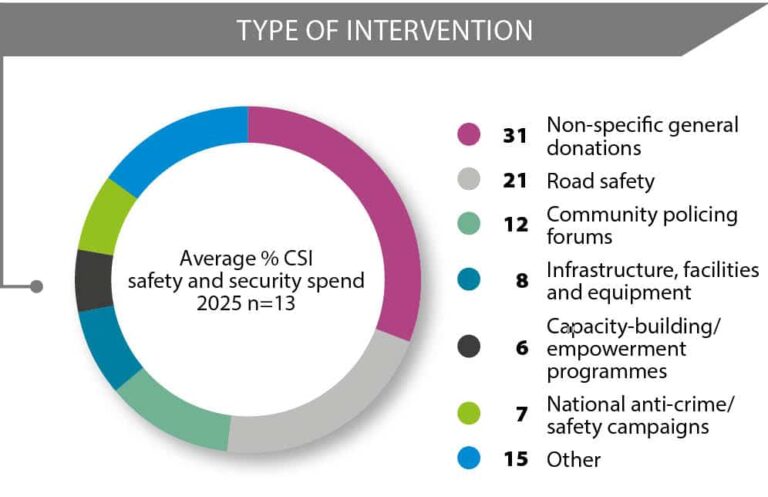
- Non-specific general donations accounted for the largest portion of CSI safety and security spend (31%).
- At 21% (slightly down from 25% in 2024), road safety was the second-most supported intervention type in this sector.
- Less than 10% of average CSI spend on safety and security in 2025 went to infrastructure, facilities and equipment (8%), national anti-crime and safety campaigns (7%) and capacity building and empowerment programmes (6%).
- Two companies reported supporting interventions focused on victim empowerment and gender-based violence (GBV).
- Other intervention types received 15% of average CSI allocations in this sector.
- Early childhood development (ECD) accounted for nearly a third (30%) of education spend on average, similar to 2024 (31%).
- Average expenditure on school-level education (general education plus further education and training) decreased slightly from 42% in 2024 to 38% in 2025.
- Tertiary education received an average of 29% of education spending, an increase from 23% in 2024 and 27% in 2023.