DEVELOPMENT TOPICS: Arts and culture

Arts and culture have long been powerful tools for social cohesion and democracy building. The creative sector preserves heritage, encourages critical dialogue, and provides a platform for storytelling and social transformation.
The ‘business case’ for investing in arts and culture in Africa is clear – it promotes social harmony, economic growth, and community engagement, even in politically challenging environments. The private sector should view the creative industries as economic drivers that can create jobs and increase a country’s export earnings.
As arts and culture increasingly work hand in hand with technology – in digital art, video games, and streaming services, for example – new markets are created, and young Africans can gain access via their cellphones.
To improve outcomes in the sector, companies can invest by:
- Funding arts education and skills development by supporting arts programmes, and sponsoring scholarships, mentorships and apprenticeships for young and emerging artists.
- Creative infrastructure by developing community art centres, galleries, and performance spaces, or fund digital platforms that showcase African artists and content creators.
- Sponsoring cultural events and initiatives such as music festivals, art exhibitions, film screenings, and literary awards.
- Commissioning artworks for company headquarters or satellite offices.
- Partnering with local artists and organisations to support cultural exchange programmes.
- Championing fair wages and royalties for artists, musicians, writers, and other content creators, and supporting copyright protection and intellectual property rights to protect African cultural assets.
Discover how your company can drive meaningful impact and support arts and culture initiatives.
National context
- The Department of Sport, Arts and Culture (DSAC) was allocated R6.3 billion in 2025/26, constituting 0.2% of the consolidated government expenditure of R2.59 trillion for the year. Of this, Arts and Culture Promotion and Development was allocated R1.7 billion and Heritage Promotion and Preservation R2.7 billion, most of which is earmarked for community library services and transfers to museums.
- Research by the South African Cultural Observatory done in 2022 and updated in 2024, indicates that the cultural and creative industry contributes just under 3% to GDP and supports nearly one million jobs.
- In August 2025, the DSAC introduced the 17 cultural and creative industry clusters framework. The clusters, which include theatre, dance, visual arts, music and book, are designed to formalise, strengthen and grow the creative economy. They aim to reduce fragmentation and create structured platforms for advocacy, enable targeted funding and policy interventions and promote skills development and market access.
- Over the 2024/25 to 2026/27 medium-term expenditure framework period, R1.2 billion is allocated to the Mzansi Golden Economy programme to create more than 60 000 job opportunities in the cultural and creative sector and place more than 1 000 artists in schools.
- The Presidential Employment Stimulus Programme, launched in October 2020 and geared towards employment creation and retention initiatives for artists, creatives, heritage sector workers and cultural workers, was allocated R362 million in 2025/26, up from R351 million in 2024/25, to create 32 000 jobs in the cultural and creative industry.
- The DSAC plans to complete the construction of 54 libraries between 2025/26 and 2027/28 at an estimated cost of R584 million. It is also setting aside R2 million to support the preservation and development of the Khoi and San languages, the N|uu language in particular.
- The South African Geographical Names Council reports that over 1 500 geographical names have been changed across the country since its establishment in 1998. The Council leads the transformation of South Africa’s naming landscape to reflect the country’s languages, cultural heritage and democratic values.
Overview of CSI spend
Arts and culture were supported by 14% of companies and received 1% of average CSI expenditure.
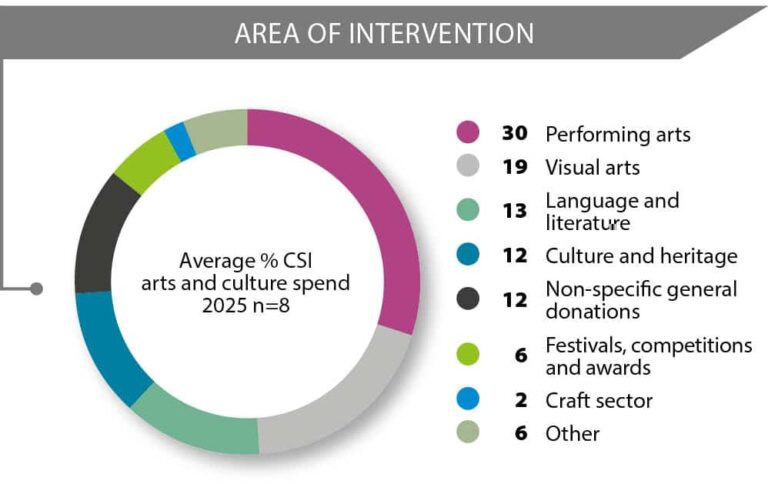
- After increasing to 59% in 2024, average CSI support for the performing arts decreased to 30%, returning to previously recorded levels (29% in 2023). These fluctuations are most likely due to the small sample sizes.
- Visual arts and language and literature received the next largest average CSI spend in the sector, at 19% and 13% respectively.