DEVELOPMENT TOPICS: Social and Community Development

Social and community development focuses on improving communities’ socioeconomic conditions through targeted initiatives, including social assistance, welfare programmes, job creation, and infrastructure development.
These efforts aim to reduce social inequalities, create employment opportunities for marginalised and economically excluded people, and establish social safety nets for those in need.
Investing in capacity building can help to make communities more resilient. It helps them find solutions to their own specific challenges rather than adopt those imposed by well-meaning donors or partners.
By co-creating programmes with communities, companies can increase trust and loyalty. However, multi-year investment programmes should assist community members in sustaining development independently, rather than placing them at risk of dependency.
A solution may be to partner with local governments, nonprofit organisations and community leaders to ensure continuity after corporate involvement ends.
Effective capacity building must prioritise co-created solutions, long-term engagement, and adaptive strategies that ultimately empower communities.
Companies can play a role in driving positive change in the sector by:
- Funding skills development and job creation programmes.
- Investing in infrastructure and community services that enhance quality of life.
- Partnering with nonprofit and grassroots organisations to implement targeted social programmes.
- Supporting education and vocational training to improve employment prospects.
- Engaging in employee volunteerism and mentorship programmes.
By strategically investing in community development, companies can drive long-term socioeconomic progress while fostering goodwill and sustainable partnerships. Before implementing programmes, companies should consider:
- Assessing community readiness, essential infrastructure, and existing skills and leadership capacity.
- How to align programmes with local values, traditions and social structures, or risk resistance and disengagement.
- Exercising patience and being consistent, since it takes time to build genuine trust relationships.
- The challenges of scaling programmes – what works in one community may not be easy to replicate in another due to different local conditions, governance structures, and social dynamics.
- Discover how your company can become more involved.
South African national context
- Government’s budget for social development increased from R397 billion in 2024/25 to R422 billion in 2025/26, constituting 16% of consolidated government expenditure of R2.59 trillion. Of this, R117 billion was allocated to the old-age grant, R99 billion to social security funds and R90 billion to the child support grant. A total of R77 billion was allocated to other grants, provincial social development, and policy oversight and grant administration.
- The budget for community development is R286 billion for 2025/26, accounting for 11% of the consolidated government expenditure. Most of this is earmarked for local municipalities, public transport and human settlements.
- As of 31 March 2025, the total number of grant beneficiaries was just over 12 million, according to the South African Social Security Agency (SASSA). SASSA paid out 19 million grants to these beneficiaries, as many people receive more than one grant (e.g. a caregiver receiving multiple child support grants). Around 13 million child support grants (R560 per child per month) 4.1 million old-age grants (R2 310 per recipient per month) and 1 million disability grants (R2 310 per recipient per month) were paid out.
- Additionally, SASSA told Parliament that over 17 million people had applied for the Social Relief of Distress (SRD) grant since its introduction during the Covid-19 pandemic in 2020. In March, Finance Minister Enoch Godongwana announced the extension of the SRD grant to 31 March 2026. The grant was increased in April 2024 from R350 to R370 a month. According to National Treasury, R35.2 billion was allocated to extend the SRD grant at R370 per beneficiary, including administration costs.
- The World Bank estimates that South Africa’s poverty rate has increased from 66% of the population living below the upper middle-income poverty line of US$8.30 per day in 2015 to 68% in 2025.
- Stats SA data indicate that the total number of unemployed people increased to 8.4 million during the second quarter of 2025, equating to a national unemployment rate of 33.2%, with a youth unemployment rate of 46.1% (for individuals aged 15–34 years). The expanded unemployment rate, which includes those not actively looking for work, stood at 42.9% overall and 62.1% for youth.
Overview of CSI spend
Social and community development was supported by 84% of companies and received 14% of average CSI expenditure.
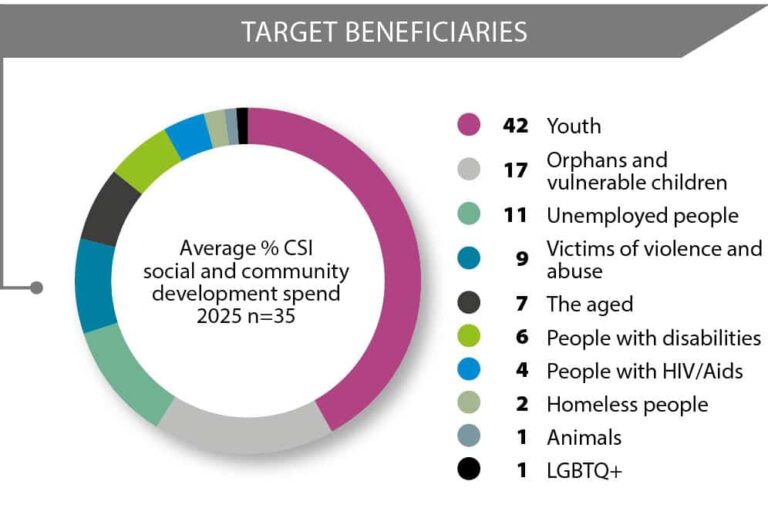
- Youth (ages 14 to 34 years) remained the primary beneficiaries in the social and community development sector in 2025, receiving 42% of expenditure on average.
- The percentage of CSI spend on orphans and vulnerable children increased from 13% in 2024 to 17% in 2025.
- Unemployed persons moved from being the second to the third most supported beneficiary group, with average spend declining from 15% in 2024 to 11% in 2025.
- All other beneficiary groups received less than 10% of average CSI sector spend in 2025, including victims of violence and abuse, the aged, people with disabilities, people with HIV/Aids, homeless people and the LGBTQ+ community. Animals received 1% on average.