

Nonprofit organisations are under growing strain as resources tighten and civic space shrinks – even as the need for a strong civil society increases.
However, capacity-building support remains inconsistent. In 2022, Trialogue’s research found that 45% of participating companies did not offer any capacity-building to nonprofits. Where support exists, it is often short-term, despite clear evidence that building organisational strength is an ongoing process.

Trialogue and the Ford Foundation held a webinar in May to explore how to build stronger, more resilient civil society organisations.
The conversation brought together Olwethu Sizani (Program Associate at the Ford Foundation), Fatima Shaik (Executive Director at People Opposing Women Abuse), and Sareta Thomas (Regional Director: Africa at Humentum), and was moderated by Sheldon Morais, Head of Thought Leadership at Trialogue.
Building institutional capacity
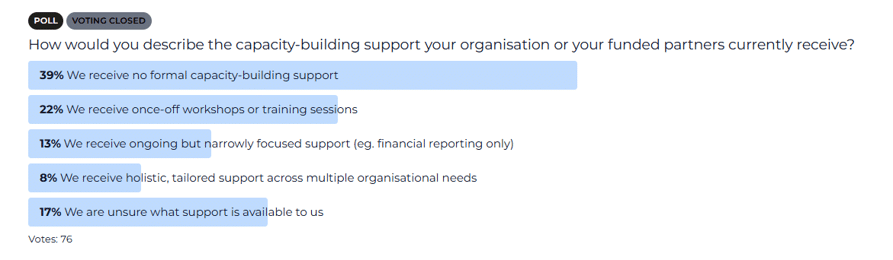
A webinar poll revealed that 39% of nonprofit attendees currently receive no capacity-building support at all.
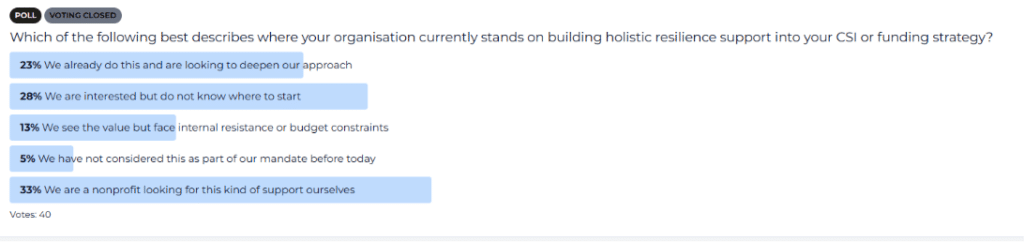
An additional poll revealed that 33% of webinar attendees are looking for holistic resilience support, with a further 28% interested but unsure where to start.
Being a resilient organisation is not just about responding to shocks – it’s about having the capacity to handle a range of ongoing pressures.
In an effort to strengthen civil society organisations in the Global South, the Ford Foundation launched the Weaving Resilience Initiative in 2022, committing US$80 million over five years to strengthen and connect civil society organisations and movements on the frontlines of the fight for social justice. This was based on a 2019 Ford Foundation survey that found many black women in leadership positions lack the support they need to drive organisations forward. The initiatives focused on building institutional capacity over time, rather than funding only programme delivery. The initiative was shaped by two key lessons, according to Sizani: effective capacity building has to be demand-led or risk being irrelevant, even extractive, and piecemeal support does not allow organisations to deal effectively with multiple pressures.
Four key areas of intervention were identified: strategy support, financial management and governance, digital security and mental wellness. The Ford Foundation partnered with smaller, more geographically remote organisations beyond its usual partner base, offering long-term funding. The model has since evolved to include leadership and coaching. To date, the initiative has supported more than 500 organisations in eight countries in southern Africa: South Africa, Zambia, Zimbabwe, Malawi, Mozambique, Namibia, Lesotho and Swaziland.
Demand-driven work
Humentum worked as one of the Ford Foundation’s partners, assisting nonprofits with financial management, financial sustainability and governance. A starting point was identifying gaps by working closely with organisations themselves. “The work had to be demand-driven, not just offering something they felt they had to take,” Thomas said. As few nonprofits have more than six months of reserves, financial resilience is key.
POWA was one of the organisations benefiting from such support. “Resilience is not an abstract concept,” Shaik said, speaking on behalf of the 47-year-old organisation, which has evolved over time “without a lot of thought”. More accustomed to responding to crises and grappling with the trauma and systemic justice inherent in GBV work, the POWA team had to take a step back to identify its own vulnerabilities and pay more attention to systems and sustainability.
In a rigid, compliance-driven environment, short-term outputs and administrative requirements tend to take priority, Shaik said. However, the Weaving Resilience Initiative’s trust-based approach allowed POWA to focus on institutional strengthening and wellbeing.
Sizani noted that many organisations are hesitant to discuss their weaknesses for fear of losing funding. Crucially, the Weaving Resilience initiative imposed no conditions or expected the organisations to meet donor requirements. An initial assessment helped organisations to map their needs to determine where to start, and not be afraid to ask for help where it was most needed.
Identifying capacity gaps
For Humentum, this process often reveals gaps between perceived and actual capacity. “Often, people don’t know what they don’t know,” Thomas noted. Many organisations believe strong documentation equates to good systems, “but there’s more to it than that.”
Through self-assessment and deeper engagement, organisations experience “aha moments”, particularly when introduced to good-practice standards. Crucially, the assessment is not a checklist but a process of understanding what effective systems look like in practice.
One consistent challenge is the siloing of financial management. highlighting the need for cross-team ownership. For POWA, this reflects a broader structural issue. Social workers and auxiliaries are highly trained in service delivery, but less equipped for organisational management. “The job is not just counselling. It evolves over time,” Shaik said.
As staff take on leadership roles, they must manage budgets and programmes without formal training. A key shift was helping managers understand how activities translate into budgets, ensuring that costs are properly planned for. Capacity building also depends on readiness, Thomas noted, adding that organisations should be able to put off an offer of support until they have the internal bandwidth for it.
Collaboration over competition
The discussion also highlighted the need for more intentional collaboration between funders and nonprofits. Sizani highlighted the role of funders in modelling this behaviour. “The responsibility lies with those with resources to work more intentionally together,” she said, pointing to pooled funding approaches such as the Weaving Resilience initiative, which builds on existing capacity rather than duplicating efforts.
For nonprofits, this may mean rethinking competition. Some organisations want the limelight, or they specialise in specific areas, but funding constraints are leading to more mergers and partnerships. “Together, we can be much stronger,” Thomas observed.
This requires more deliberate effort: mapping the landscape, identifying suitable partners, and engaging before launching new initiatives.
Strengthening organisations, not just programmes
A recurring theme was that capacity building must extend beyond individuals to the organisation as a whole.
“Don’t offer support to a single person,” Sizani cautioned, “Be willing to open the support to as many people as possible. It builds sustainability and resilience.” Many community-based organisations have high staff turnover, and when people leave, funders must reinvest. Instead, support should be opened to teams across functions – including budgeting, which should not be limited to finance staff.
Funders need to recognise the importance of organisational capacity development, Thomas said, stressing the importance of funding that covers administrative costs, staff development and systems.
Shaik echoed this from experience. “Resilience is not an abstract concept,” she said. The support POWA received enabled the organisation to revisit its strategy, financial systems and governance after decades of largely reactive work. She said the process was “intense and painful but worthy” and revealed gaps in policies, roles and risk management.
Investing for the long term
The webinar closed with a strong call for a shift from short-term, transactional funding to longer-term, trust-based partnerships.
“Be willing to invest the time before investing the money,” Sizani said, emphasising the importance of understanding partners’ needs and co-designing support. This requires flexibility, openness to learning, and willingness to invest in the long term.
Thomas urged organisations to look inward as they plan ahead. “It’s tough out there, we all know it. But look inwards to see how you can change and do better.” Integrating financial management across the organisation and focusing on long-term goals are critical to resilience. For funders, Thomas said listening to partners and extending unrestricted, long-term funding is crucial.
For Shaik, the stakes are existential. “Organisations can’t pour from an empty cup while responding to a national crisis,” she said. Moving beyond transactional funding to genuine partnership “helps to build organisations’ resilience” and creates the conditions for sustainable impact. “Wellbeing is not separate from the impact work, but makes it possible and sustainable,” she concluded.
Webinar attendees agreed that inconsistent and short-term funding cycles remain the biggest barrier to nonprofit sustainability in South Africa (76%), while 15% cited limited strategic planning capacity.

Ultimately, building resilient nonprofits will require funders and organisations alike to move beyond short-term transactions towards long-term, trust-based partnerships.
Watch webinar here
Find out more
Read more about nonprofit capacity building, resilience and many other responsible business and development topics on the Trialogue Knowledge Hub.
Read the article ‘Capacity building in the nonprofit sector’ on the Trialogue Knowledge Hub.
Sign up for the ‘Nonprofit resilience’ course on the Trialogue Academy, a self-paced online programme designed for nonprofit leaders, managers, board members and executives who need practical tools to build, lead and manage more resilient organisations in an increasingly uncertain environment. The course is also of value to corporate funders and CSI practitioners who want deeper insight into what healthy, resilient nonprofits look like and how to apply this understanding when designing, supporting or assessing corporate social investment strategies.
