

Companies and corporate foundations hold trillions of rands in assets, and the way they deploy these assets influences value chains, market systems and outcomes for people and planet. In March, Trialogue held a webinar exploring how companies can leverage impact investing strategies for impact.
The panellists were Sameera Munshi (Anglo American Foundation), Frank Aswani (African Venture Philanthropy Alliance), Bright Ndhlovu (Blue Sky) and Nick Rockey (Managing Director, Trialogue). The webinar was moderated by Jeremy Doyle (Trialogue).
What is impact investing?
Doyle defined impact investing as the deployment of funds with the intentional pursuit of both financial return and social or environmental impact. In the continuum of capital, it falls between traditional investing and traditional philanthropy.
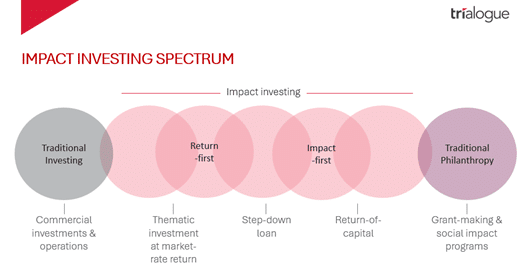
Figure 1: The impact investing spectrum, adapted from Rockefeller Philanthropy Advisors
Corporate impact investing – an emerging field – has no single model, but there are two important dimensions: who drives the intervention and what strategy is used.
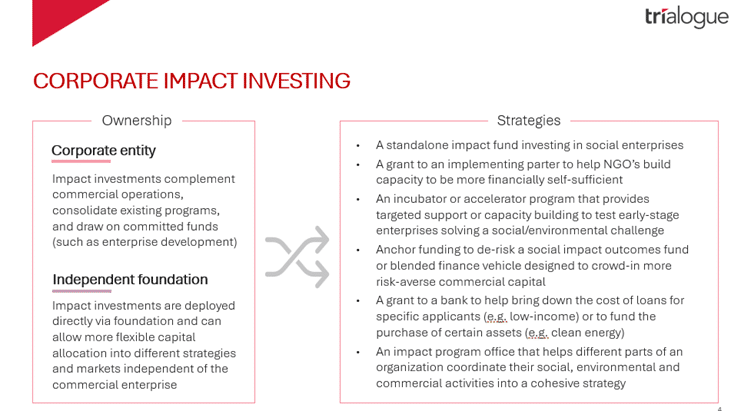
Figure 2: Corporate impact investing
Impact investing can sit within the company itself, often led by sustainability or corporate affairs and funded from the balance sheet, or be driven by a corporate foundation. Integrating impact investing within a company can help consolidate, streamline, and augment existing initiatives and programmes. Foundations typically have greater independence, which may allow them to deploy more flexible, patient capital or to test new approaches.
Why does Africa need impact investment?
Aswani argued that impact investing is essential to closing Africa’s Sustainable Development Goals (SDGs) financing gap, estimated at around $250 billion a year as global aid declines. This requires deploying the full spectrum of capital – using philanthropic risk capital to test and prove new models, then crowding in corporate and private funding once innovations, markets and services demonstrate viability.
“We will not achieve the SDGs without private capital,” he said. “There is simply not enough money to close the financing gap Africa is facing from traditional sources of capital, and there is not enough risk capital to de‑risk social investments.”
While companies often engage through CSI, Aswani stressed that challenges such as youth unemployment are now material business risks that demand deeper involvement. The real constraint, he argued, is not intent but knowledge and confidence. Africa needs more catalytic capital to fund small, well‑designed experiments that build proof of concept, reduce risk and create track records investors can back. By pooling capital, sharing risk and learning collaboratively, investors can test what works in African contexts and then scale it. Africa is uniquely positioned as a proving ground: solutions that work here can advance the SDGs locally while remaining globally scalable.
Case study 1: Anglo American Foundation’s Aséli Impact Capital
Munshi explained that Aséli Impact Capital was created to address a persistent gap in South Africa’s green economy: while there is no shortage of capable innovators, many are stuck in the structural “missing middle” – too advanced for grants and early debt, yet too risky for commercial finance. Without intervention, these businesses often fail not because of weak ideas but because capital is not designed to fit their operating realities.
In response, the Anglo American Foundation partnered with Savant in 2023 to test a different approach, using philanthropic funding to run low‑risk experiments and build proof of concept before committing to a permanent vehicle. Krutham later joined as a strategic and technical partner. The result was Aséli, an evergreen capital vehicle with no fixed exit, investing through revenue‑based, redeemable preference shares linked to business performance – allowing enterprises to repay sustainably while capital is recycled.
“Wrapped around all of this is technical assistance: governance, strategic support, impact tracking, and ensuring the business is able to scale and repay sustainably. In the next phase, they are ready for commercial capital,”
Munshi explained.
She stressed that Aséli’s most important lesson has been the value of partnership and learning by doing. Rather than designing the vehicle alone, the Foundation drew on Savant’s investment expertise and Krutham’s depth in governance and impact management. This collaborative, “ego‑free” approach enabled the partners to navigate complex legal and structuring challenges while keeping a clear “North Star”: designing capital around what impact businesses actually need.
Beyond direct investment, the Foundation has also used grant funding to test models in areas such as waste and circularity, supporting efforts to verify and track waste across the value chain. Proven first in Gauteng and now replicated in the Northern Cape, this work shows how philanthropy can absorb risk, test solutions in complex systems, and generate the evidence needed to unlock scalable, investable models. For funders entering this space, the message is clear: start by testing, lean on experienced partners, and use philanthropic capital to de‑risk innovation so that private capital can follow.
Case study 2: Blue Sky Impact in Onseepkans
Ndhlovu pointed to Onseepkans, a remote rural town in the Namaqua District of the Northern Cape, as a rare example of how land restitution can translate into sustainable economic activity when the right structures and long‑term partners are in place.
The project emerged from a land restitution process concluded in 2005, which transferred around 90 hectares of land along the Orange River to 114 community members. While land ownership was secured, Ndhlovu stressed that this alone was not enough. “When you give a parcel of land to people, you can’t take it away and put it into a company,” he explained. “So how do you operate from a business perspective when the land is locked up in close corporations?”
Blue Sky Impact helped the community establish a trust structure that retains land ownership while enabling commercial activity through an operational company, Osk DevCo (also known as Elmboog). The Onseepkans Raisin Farm is one of only two 100% black-owned organic raisin farms in the region.
Osk DevCo runs all farming operations and holds the means of production, while remaining fully community‑owned through the trust. Community‑elected trustees sit on the board alongside experienced directors, creating what Ndhlovu described as “a beautiful mix of experience and those growing in the governance space”. The model keeps assets, decision‑making and returns locally anchored, while allowing the business to trade, employ people and access finance on commercial terms.
From a modest first harvest valued at around R170 000, the organic raisin operation has generated R20 million in revenue since 2016, making it one of the few land‑restitution farms in the region to reach this level of maturity.
A turning point came in 2022, when Scatec, a renewable energy solutions provider, joined the partnership as a long‑term impact investor. Earlier grant funding had supported production but left gaps in business development, governance and financial management. Scatec’s patient capital helped bridge these gaps, subsidising expertise while revenues were still building and giving the project “time to breathe”, with more than half of revenues now flowing back into the community through wages and local economic activity.
Ndhlovu likened the model to an anchor-tenant strategy: the core farming business acts as a catalyst around which additional enterprises – such as water, waste and recycling initiatives – can emerge, strengthening the local economy and creating a platform that can be replicated in other rural contexts.
Leading with curiosity
Rockey noted that the impact investing journey is only just beginning for companies, with real opportunity ahead in identifying ground‑level solutions that can be scaled. With the right mindset, he said, companies can operate “developmentally and commercially at the same time”, recognising that profits are not necessarily “off the table” when social and environmental outcomes are built into the model from the start.
“Purpose‑led companies with a clear North Star are better positioned to experiment, learn and scale, particularly when they partner rather than go it alone,” he said. Too often, funding and expertise sit in silos, while governance and ownership structures – especially in community or restitution contexts – are complex and “not plug‑and‑play”. His call was for deeper, trust‑based partnerships that go beyond transactional funding. “Be curious,” he urged, and invest in the right partners, noting that learning together may take longer, but leads to more durable, effective solutions.
From the margins to the mainstream
In closing, the panellists agreed that impact investing is moving from the margins towards the mainstream. Over the next five years, they expect philanthropy to play a bigger catalytic role, deploying capital more flexibly to support SMMEs and unlock sustainable growth. Long-term partnership and patience will be essential: meaningful impact takes time, commitment, and structures built to last.
Aswani said the current funding crisis should be seen as an opportunity to shift from a compliance mindset to a greater commitment to home-grown solutions. “Collaboratives should be built around the problem, not the solution,” he noted.
“Fall in love with the problem first, then build solutions on the strengths of the convening parties.”
If done right, Aswani said, impact investing can move confidently into boardrooms, proving that profit and purpose are not opposing forces, and that solving human needs can also make commercial sense.
Watch the full webinar recording to learn how your company can leverage the panellists’ insights for greater impact.
Find out more
- Read Trialogue’s article on how companies can reshape development finance.
- Read more about Aséli Impact Capital and the Anglo American Foundation’s impact investing journey.
- Read more about Blue Sky Impact’s flagship project, Onseepkans Raisin Farm.
- Find out more about recent trends in corporate impact investing from the Global Impact Investing Network (GIIN).
