
Unlocking inclusive entrepreneurship starts with tailored design
In October 2026, Trialogue and Absa hosted a webinar covering what it takes to make entrepreneurship development inclusive. The discussion unpacked how to design inclusive entrepreneurship support programmes that are driven by entrepreneurs’ needs to build businesses that last after the programme ends. The panel included Nonhlanhla Magagula, Head of Corporate Citizenship Programmes at Absa; Linda Hasi, Group CEO of the Young African Entrepreneurs Institute (YAEI); Emmanuel Moledi, Founder of Bemo Bees; and Professor Anastasia Mamabolo, Absa Chair in Entrepreneurship at the Gordon Institute of Business Science (GIBS).
Key takeaways for inclusive entrepreneurship support:
- Enabling inclusive access starts with the design of entrepreneurship programmes.
- Design entrepreneurship support around different entrepreneurial journeys and motivations.
- Ecosystem partners need to plan for the next level of support before the programme ends.
How inclusive is entrepreneur support?
Data from the Trialogue Business in Society Handbook 2025 and other research show the extent of difficulties blocking broad entrepreneurial participation:
- Entrepreneurs and small businesses received only 5% of total CSI spend in 2025. Much greater levels of support were provided by companies’ enterprise and supplier development (ESD) programmes.
- Skills development accounted for 70% of average CSI spend on entrepreneur and small business support in 2025, up from 57% in 2024, while finance fell to 7%, suggesting that CSI support is focused on capability rather than capital.
- Only 21% of companies reported that the entrepreneurs and small businesses they supported through CSI were also part of their value chain; this was down from 52% in 2022 and could hinder market access. The FinMark Trust’s FinScope MSME South Africa 2024 survey found that only 28% of the country’s approximately three million micro, small and medium enterprises (SMMEs) were formal, compared to 56% informal and 16% semi-formal.
- The Shoprite Group, in their 2026 State of the SMME in South Africa, found that women owned 50% of micro businesses (the smallest businesses employing one to five people), but just under 13% of medium-sized businesses (mid-sized businesses that employ 51 to 200 people).
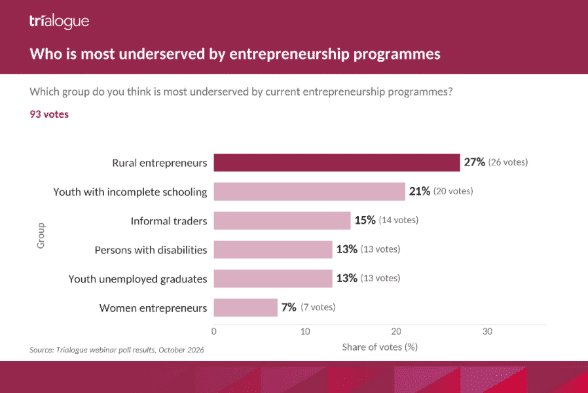
Poll responses during the webinar named rural entrepreneurs (27%) as the group most underserved by entrepreneurship programmes, followed by youth with incomplete schooling (21%) and informal traders (15%).
Access to markets and networks was the most common answer on the biggest barrier to inclusion in entrepreneurship support, with 31% of the 72 votes. How support programmes are implemented followed at 18%.

Absa’s ecosystem approach
Magagula shared Absa’s approach to promoting inclusive entrepreneurship across the ecosystem using entrepreneurship education, startup funding and research:
- Inspiring an entrepreneurial thinking mindset in school learners through entrepreneurship education in schools as a partner to E³, an initiative that supports the Department of Basic Education.
- Igniting entrepreneurial intent among students through embedding entrepreneurship education, entrepreneurship in teaching and research, and developing entrepreneurial universities in partnership with the Department of Higher Education and Training (DHET), Universities South Africa (USAf) and Entrepreneurship Development in Higher Education (EDHE).
- Nurturing business skills through capacity building and startup capital for youth not in education, employment or training (NEET), working with implementing partners like the YAEI across South Africa. In 2026, the Absa Youth Entrepreneurship Fund was launched to advance training, funding and mentorship to entrepreneurs from disadvantaged backgrounds to launch and scale their businesses through tailored support.
- Incorporating research to assess programme impact, inform programme design and share learnings with the wider ecosystem through research partnerships with GIBS and the Allan Gray Centre of African Entrepreneurship.
An entrepreneur’s journey
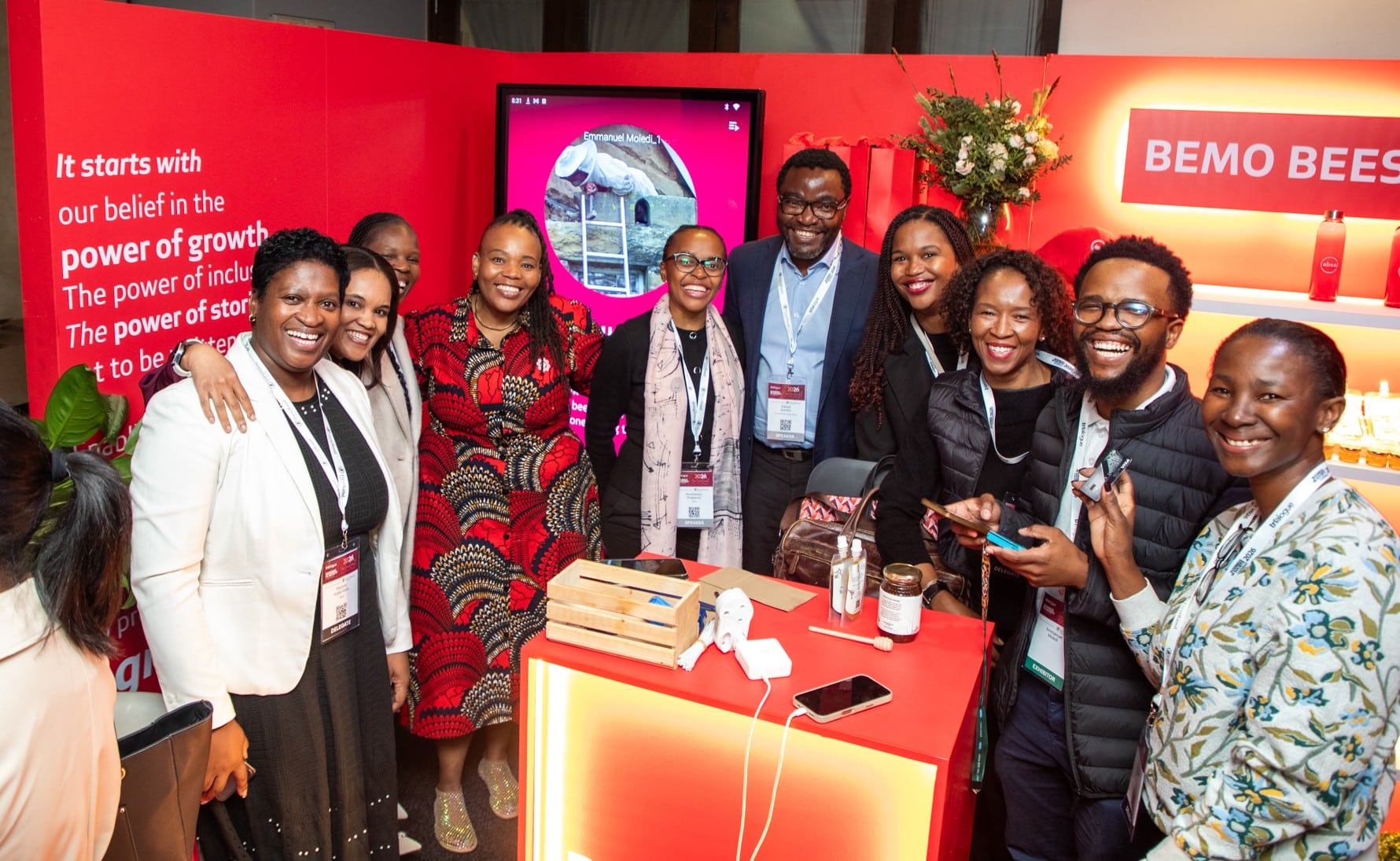
The entrepreneur on the panel highlighted the critical gap between what entrepreneur support programmes deliver and what entrepreneurs need. Moledi founded Bemo Bees, a business that produces honey, removes bees and has started offering beekeeping training. He joined a YAEI programme while the business was still developing and looking for startup support. His experience highlighted the challenge entrepreneurs face when programme support ends, but the business still needs handholding.
Hasi leads an entrepreneur support organisation that is an implementing partner to Absa’s youth entrepreneurship programmes. He shared how his organisation supports both the young person and the business with business skills and mentorship to grow from a business idea to a startup and sustainable growth.
Enabling inclusive access starts with the design of entrepreneurship programmes
The panel discussion emphasised a critical point: expanding reach is not only about who qualifies for programmes, but also how support is delivered, whether potential beneficiaries can take part equally, and what happens after the programme ends.
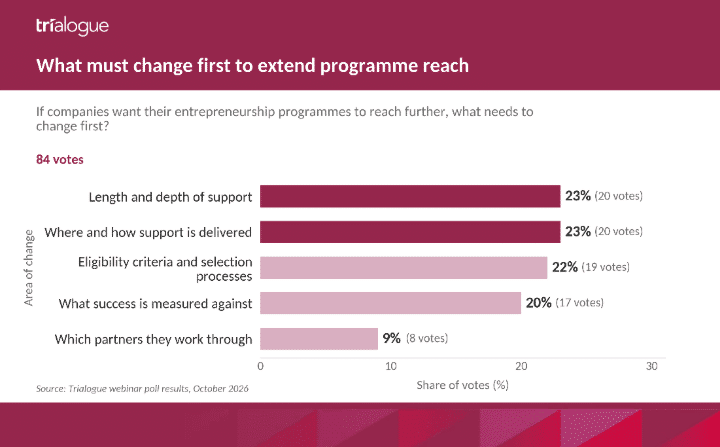
When asked in a poll what companies should change first to extend the reach of their programmes, the results were fairly even. The length and depth of support, and where and how it is delivered, each received 23% of the votes, while eligibility criteria and selection processes were also flagged as needing improvement.
Hasi explained the YAEI district level approach designed to work in local areas where entrepreneurs do not have to travel far to access training venues. As a response to limitations on selection processes, he noted that “we do give grace to those that walk in to say, yes there is a particular application, but because you are here and we are a developmental organisation, we will give that opportunity to these young people”.
The discussion also highlighted the tension between targeting businesses with scaling potential over support for entrepreneurs who enter into business for personal survival. Professor Mamabolo argued that youth seeking post-school opportunities need support at the appropriate level and that programmes must identify ways to support both informal and formal businesses.
Design around different entrepreneurial journeys and motivations
Magagula said Absa designs for different starting points because young people “are not a homogeneous group”. Even among those not in employment, education or training (NEET), some have completed matric, some have not, and some have self-taught skills or certifications. Absa therefore matches its support to life stage, and this sets out what inclusion means in practice for different groups of potential entrepreneurs who face risk of exclusion.
Magagula relayed that evidence informing the design of Absa’s programmes came from annual dialogues that include young people, site visits and independent impact studies. “We cannot sit behind desks and just receive reports that are emailed to us by the partners that we work with,” she said.
Hasi explained that some entrepreneurs start out of need, not passion, and that immediate needs can pull capable people away from long-term investment. He called this “bread versus business”. YAEI has seen interest fall away when a skills programme offers no stipend. One response is to let part of a grant support the entrepreneur’s own sustenance, with the rest going to product and business development.
Professor Mamabolo argued for the delivery of interventions based on evidence of actual entrepreneurs’ needs – rather than assumptions – to ensure responsive support is embedded in the strategy from the beginning. She also challenged using revenue as the only measure of an entrepreneur. She argued that entrepreneurial thinking and action are the basis for developing successful entrepreneurs, and that support must be built on evidence of what entrepreneurs need, “not on what we think the entrepreneurs need”.
She emphasised the need to reach the ‘forgotten group’ of recent school leavers outside formal support, as they are outside schools, universities or networks of entrepreneurial communities and they often cannot get mentorship or coaching because those services ask for formalised plans. She added that sponsors tend to go to urban schools because they are easier to reach, while rural learners may struggle to find even R50 to attend an entrepreneurship day.
Plan the next level of support before the programme ends
Support organisations with an ambition to drive inclusive entrepreneurship may need to rethink support that relies too heavily on capability building without the capital needed to link SMMEs to markets and company value chains. Moledi shared how a gap appeared when the structured support from a programme ended: “My working capital is not the same anymore. So how do I now operate the business without the extra funding that I had?”
He looked for additional income on his own, adding training and pollination services alongside honey sales and removing bees. He shared that this experience taught him the value of follow-on support, noting that “even if it’s not financial assistance, support should carry on for a long time”. He urged support organisations not only to measure success by programme completion, but also to consider market access, capacity building and enabling funding to meet new demands emerging from growth.
Hasi described how YAEI keeps that connection through ecosystem hubs, a digital platform for continued engagement and mentorship, and FlexiHub for compliance and formalisation. It also brings in partners such as Absa, the National Empowerment Fund (NEF), and the Sector Education and Training Authorities (SETAs) to coordinate support. He acknowledged that post-programme support is heavily constrained because resources must also serve new cohorts.
Professor Mamabolo said many family businesses in communities don’t succeed because they lack the mechanisms and structures to survive post the funder. She shared that her work with township entrepreneurs focuses on formalising businesses so that they can become a legacy for families and communities. Through the research chair, she aims to uncover how “young people can be kept in their businesses, and how those businesses can become established so that young entrepreneurs can move past the notion that every business will fail in the first three years”.
Absa’s ecosystem partnership model brings stakeholders together so that when one organisation finishes its piece, another can continue. “If the ecosystem does not work, then I think we will not see the desired outcomes…when I finish, somebody else is able to continue the conversation [and] at the end of the journey to say, what has really been the shift,” Magagula noted.
The discussion reinforced the value of collaboration to support young entrepreneurs. Entrepreneurs need support that reflects what drives them and what support they can access. They also need a clear path to follow-on support that will unlock market access, funding or ongoing mentorship. For funders and support organisations, the most critical role they can play is in ensuring continued, collaborative support that is backed by evidence.
Watch video here
Additional reading
- How Absa is opening pathways to economic activity through entrepreneurship education, Trialogue Business in Society Conference 2026.
- Shoprite Group: The state of the SMME in South Africa 2026
- How Absa is driving an entrepreneurial mindset revolution for SA — Trialogue Business in Society Conference 2025.
- Enabling intergenerational inclusion through entrepreneurship, presented in partnership with Absa, Trialogue Business in Society Conference 2024.
- Absa and NID Training empower youth with disabilities through entrepreneurship programme, BizCommunity, April 2026.
- Special report highlights ways to support women entrepreneurs in South Africa, Global Entrepreneurship Monitor, February 2026.
- Empowering women entrepreneurs through inclusive support hubs, Human Sciences Research Council, February 2026. A focused policy brief on inclusive support hubs.
- How mentorship empowers women entrepreneurs, UN Women, 2025.
- Absa CSI Trust Impact Report 2025, Absa CSI Trust Impact Report 2025.
- FinScope MSME South Africa 2024: Key findings highlight urgent need for informal sector support, FinMark Trust, September 2024.
