
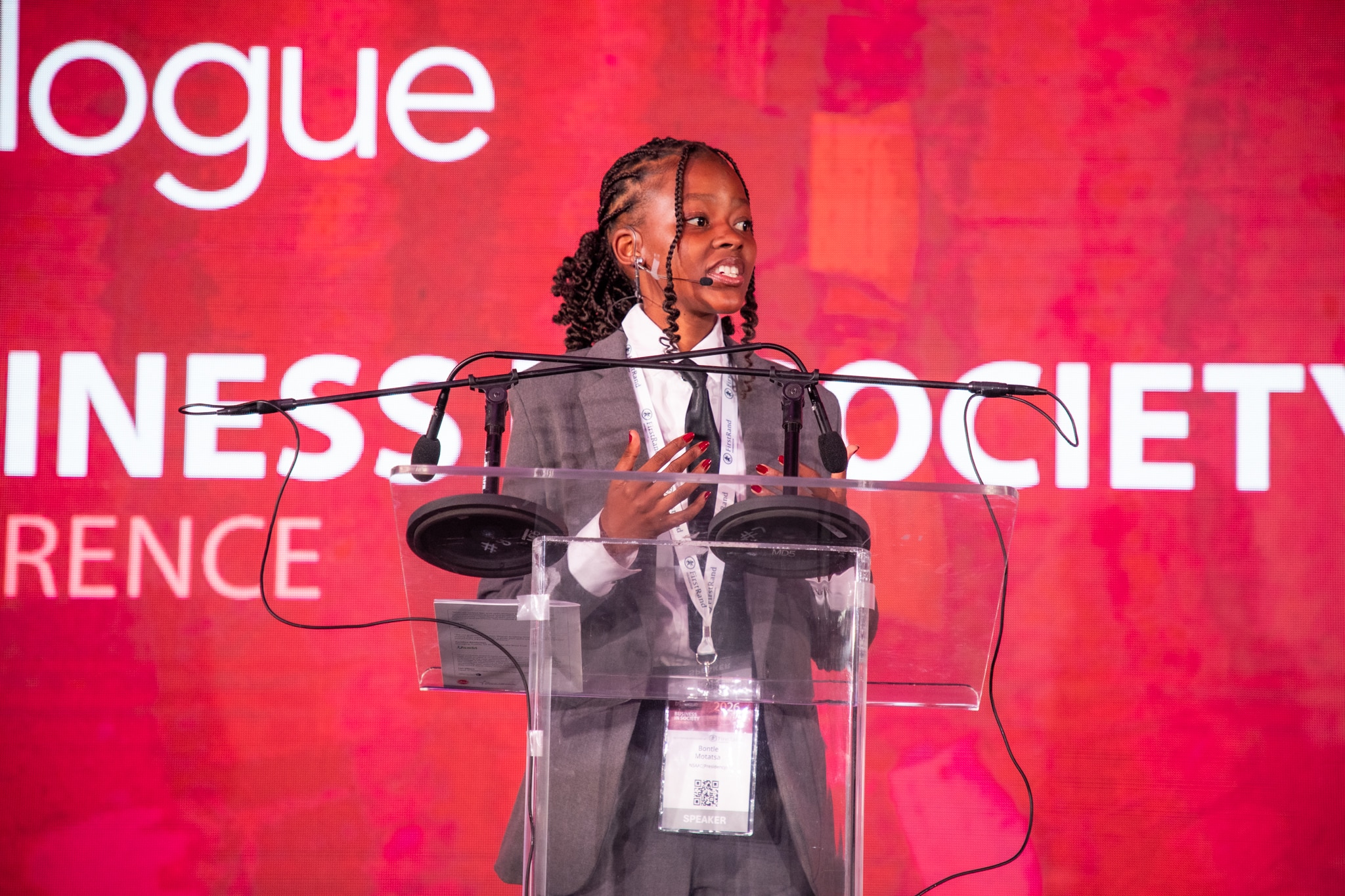
Social development efforts are slowly moving from top-down, imposed interventions to more inclusive, participatory models that acknowledge the interests of those they are intended to help. As the sector navigates this shift in thinking, any reluctance to such a decentred approach can be countered by the richness that emerges when marginalised voices are given a platform.
This was evident at the Trialogue Business in Society Conference 2026, when the National Strategy to Accelerate Action for Children Representative for Children and Adolescents, Bontle Motatsa, took the stage. Her illuminating and instructive call for the inclusion of youth in decision-making processes made the case for participatory practice.
Opening with the metaphor and established reference of South Africa as the ‘rainbow nation’, Motatsa noted how rainbows tend to be taken in as a single entity, with observers assuming they have seen all there is to offer. However, within each colour of that rainbow, there are shade variations that go unnoticed unless the viewer makes the intentional choice to look more closely.
Positioning the conference audience as the visible spectrum of decision makers, funders, and implementers, or voices that are generally heard, she identified herself as part of the spectrum that is “not intentionally and consistently zoomed into,” a representative of South Africa’s overlooked youth.
Types of inclusion
Motatsa distinguished two kinds of inclusion. The prevailing version amounts to presence, being in the room, acknowledged and perhaps consulted, but without real influence on outcomes. “It can be participation without influence, visibility without power,” she commented. By contrast, meaningful inclusion is “participation with influence where young people shape priorities, inform decisions, and define outcomes.”
It is the space between these two where tokenism lives, Motatsa argued. She commented that, despite a proliferation of conferences, frameworks, policies and commitments centred on youth participation, young people are routinely “brought into spaces when decisions are already made and consulted without any clear influence on outcomes.” Far from being simply poor practice, she noted that this is a rights issue. South Africa’s ratification of the United Nations Convention on the Rights of the Child gives the nation’s young people explicit rights to participate in decisions that affect their lives. “Participation is not a favour that should be extended to us. It is a right that requires implementation,” she asserted.
Current realities, influences of the past & future responsibilities
Motatsa also made the practical case for inclusion, drawing a direct line between youth participation and the effectiveness of development programmes. Young people, she argued, exist at the intersection of generations, carrying present realities, the influence of the past, and responsibility for the future. Including them in processes and decisions enables them to translate ideas across age groups, languages and lived experiences, moving information out of boardrooms and into communities “in ways that the community uniquely understands, is able to trust and act upon.” Such inclusion translates to ownership, which generates accountability and in turn generates sustainability, “and what you’ll be most interested in, a return on your investment,” she quipped.
Conversely, programmes whose design fails to include young people tend to lack context, struggle with uptake and fail to sustain impact. Motatsa described the results of these as “well-funded guesswork,” adding that “programmes designed for young people without young people are not solutions, they are assumptions.”
Meaningful inclusion over convenience
Recognising her own elevated position, she was quick to acknowledge that not all young people are equally positioned to participate since not all have the language, the confidence or access to formal spaces. However, this reality cannot be an excuse for defaulting to those who are easiest to reach. Social development has a duty to do more than “choose convenience over meaningful inclusion”.
Motatsa described genuine inclusion as deliberate design. This, she explained, involves engaging young people in their own contexts, recognising that insight does not always arrive in polished language, and building continuous, rather than once-off, structures. Importantly, it also requires feedback loops that keep young people informed about how their inputs have influenced decision-making. Without this follow-through, she said, the message to young people is unambiguous; “it means our inputs are not important to you, that they do not matter.”
While frameworks such as the National Strategy to Accelerate Action for Children, the National Youth Policy, and platforms like the Y20 and the Children’s Forum under South Africa’s G20 processes provide a foundation for the inclusion of youth, they cannot function in isolation. What is required is greater alignment among government, the private sector and civil society and a more focused shift from support in principle to action in practice.
Closing with a return to her opening image, Motatsa commented that, if South Africa is unwilling to do this work, “the rainbow nation will remain just a vision.” In the same way that a rainbow is not made of colours in isolation but by a blending of light, nation-building requires connection, collaboration and ensuring that all stakeholders are visible, active participants in the change process. Young people, she concluded, are not separate from this process. “We are the bridge. The link between community and institutions, between present realities and future outcomes.”
