
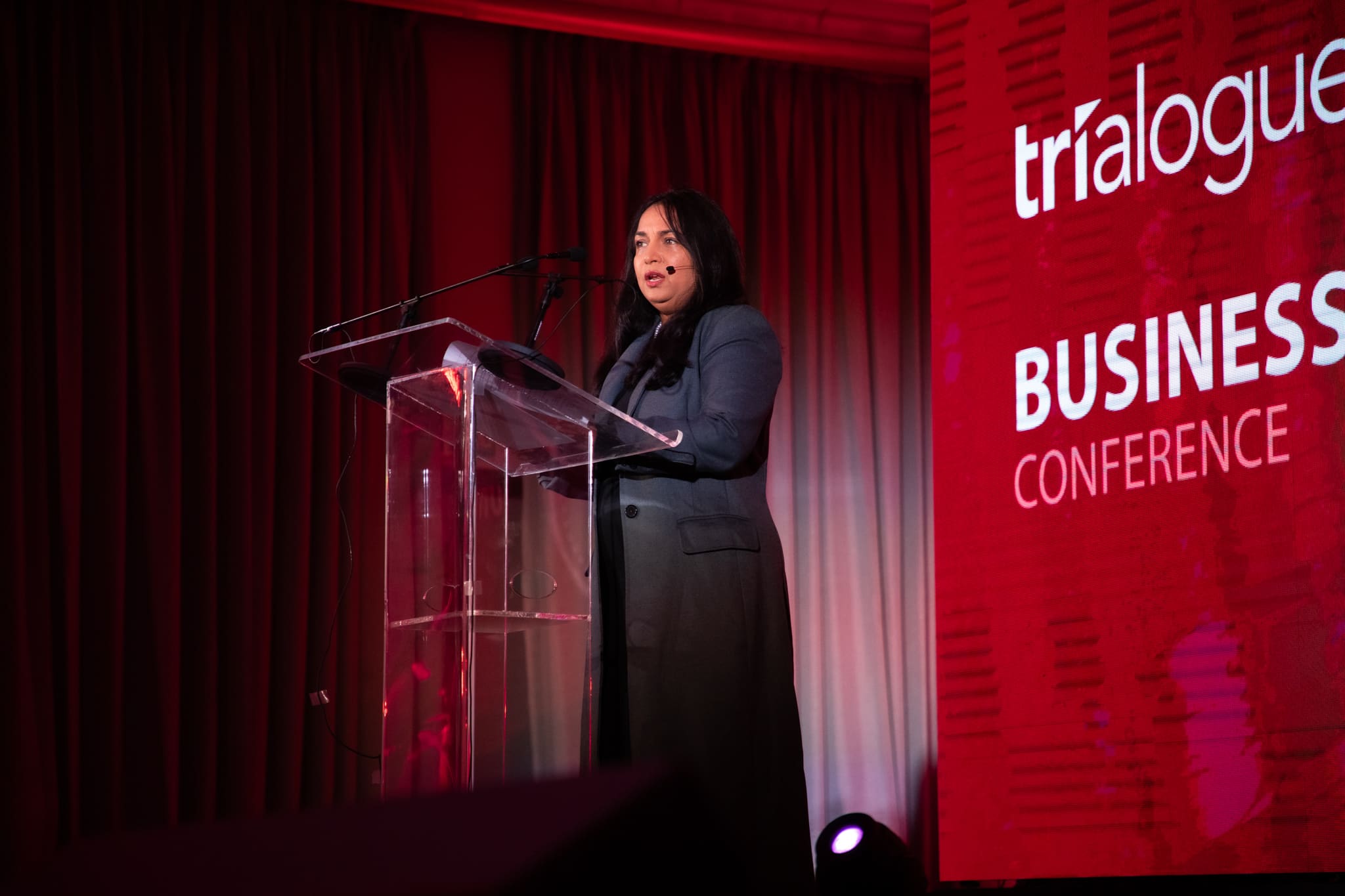
Every decision a business makes is an act of world-making and future-building. In her opening address to the Trialogue Business in Society Conference 2026, National Business Initiative (NBI) CEO Shameela Soobramoney examined how the decisions businesses make and the values that underpin them have real-world implications for economic participation and social development.
“It’s what we choose to fund, what we choose to build and not build, what we choose to lobby for…what we choose to measure and what we choose to ignore. These decisions affect who participates in the economy and who remains outside of it,” she asserted.
Anchoring her address in a conversation she had with a young woman who had done everything asked of young people in our society – completing her education and applying for jobs – but receiving nothing in return, Soobramoney highlighted how young people need an enabling environment in which to learn and grow. The encounter and common sentiment illustrate the distinction between preparation and participation. “It is where policy intent meets implementation, and where the real work lies.”
CSI as a catalyst for economic inclusion
Soobramoney acknowledged genuine progress, including more sophisticated environmental, social and governance frameworks, a resilient corporate social investment (CSI) sector and sustainability managing to hold its place on the agenda. However, she noted that alongside this progress, key challenges of poverty, inequality, unemployment and environmental degradation have stalled or, in some cases, seen a reversal of earlier gains.
Global funding cuts, she observed, have exposed the vulnerability of the civil society sector. While corporate giving has remained relatively stable, a gap has opened, requiring companies to step in with greater strategic intent. CSI, she argued, has an obligation to step in with greater strategic intent, catalysing economic inclusion by investing in the institutions and ecosystems that enable sustained participation, rather than providing temporary relief. Calling on business to collaborate towards systemic change, Soobramoney said CSI needs to define the new frontiers of what it really means to blend capital.
Revaluating the values that determine action
Building long-term value depends on systems that are inclusive, stable and sustainable, Soobramoney said. Failing to do so is creating deferred risk. Working towards these requires a close examination of values. “Values are not what we post on platforms but what show up in what we do and what we tolerate. They show up in trade-offs, when profit conflicts with inclusion, what wins? When speed conflicts with participation, who is left out? When short-term performance conflicts with long-term resilience, what gives? This is where values live. Not in policy documents, but in decisions made under pressure.”
Drawing attention to the NBI’s founding principle, that business cannot thrive where society fails, Soobramoney called on business to lead a process towards national resilience, the resilience on which all businesses depend on to grow.
She described the business leadership needed to achieve this as one that moves from intention to implementation, restoring dignity through economic participation.
Illustrating, by way of example, how intentional and inclusive programmes have transformed individual lives, Soobramoney said that such initiatives have a face and a heartbeat. Climate finance initiatives are channelling billions into new-growth-sector employment and sector resilience, while quietly shaping a new kind of economy that secures low-carbon futures and the associated multipliers that accompany them.
Soobramoney urged the social investment community to move beyond intent, fragmented efforts and siloed efforts as a matter of urgency, shifting from spending to investing in social outcomes. “Projects need to shift into systems and system change, outputs into outcomes. When we align capital around shared priorities, we do move from incremental impact to systemic change.”
She pointed to the Edelman Trust Barometer’s finding of rising trust in business as both a signal and an opportunity. Businesses that understand trust as a competitive advantage, she argued, are better positioned for the future, with inclusion driving innovation and sustainability underpinning resilience.
Her address called on audiences to align capital, values and partnerships into shaping a competitive economy. She challenged the sector to ask the following questions as an indicator of a company’s real values;
- Who is in the room when the most important decisions are made, and who is not? If key stakeholders are not there, why are they not there?
- What are you measuring and ignoring because it’s harder to quantify?
- What behaviours are being rewarded inside your organisation?
On climate specifically, she noted that environmental protection is too often treated as a constraint rather than a core value, and that this will not change until climate risk is consistently translated into financial terms and placed squarely on the boardroom table. She also flagged the emerging discussion around mandatory sustainability reporting in South Africa as a significant opportunity, provided the frameworks are oriented toward the right outcomes, namely poverty, inequality, unemployment and a just transition.
The importance of inclusion
Her examples reflected the value of including diverse voices in the development process. “We need to confront a hard truth. We often design solutions for communities rather than with them, and then wonder why the impact does not sustain. Inclusion is not a moral add-on. It is a design principle. When inclusion happens, impact lasts longer and creates the foundation for the long-term growth that we are all seeking.”
Creating time to think
Soobramoney closed with a practical, pointed call to business leaders to make time to think, despite the constant noise and distractions in our environments.
She cautioned against reaching for technological shortcuts, including artificial intelligence tools, as substitutes for substantive engagement with real voices and real problems. Strategy, she suggested, should come from listening.
Reflection and systemic thinking are imperative for successful outcomes and essential for adequate consideration of the values needed to achieve inclusive growth and to build corporate strategies that invest in creating the world we want. “If we don’t, we’ll miss the opportunity for our money to be an architect for the future.”
