
In 2025, geopolitical shifts and Western policy changes disrupted development and corporate giving in the Global South. Macroeconomic pressures led many companies to cut or rethink CSI budgets, even as expectations for meaningful social impact grew. With nonprofits stretched to deliver more with fewer resources, tracking emerging trends has become critical.
In January, Trialogue held a webinar exploring how CSI practitioners and nonprofits can adapt, remain effective and leverage emerging trends to drive real social impact in 2026. The panellists were Nick Rockey (MD of Trialogue), Patricia Loyola (director of management and social investment at Comunitas in Brazil), and Aarti Mohan (co-founder and partner at Sattva in India). The session was moderated by Sheldon Morais, Trialogue’s thought leadership manager.
Global CSI trends
The Trialogue Business in Society 2025 analysed corporate giving trends in South Africa, Brazil and India during 2024/25.
In South Africa, corporate social investment (CSI) spending in 2024/25 remained stable in real terms and grew slightly in nominal terms, in line with inflation, reflecting continued corporate commitment despite economic constraints. Brazilian companies recorded strong CSI growth, with a significant year-on-year increase in total investment. Median direct cash giving has declined in recent years, while non-cash giving (such as in-kind support) has risen.

Source: Trialogue Business in Society Handbook 2025
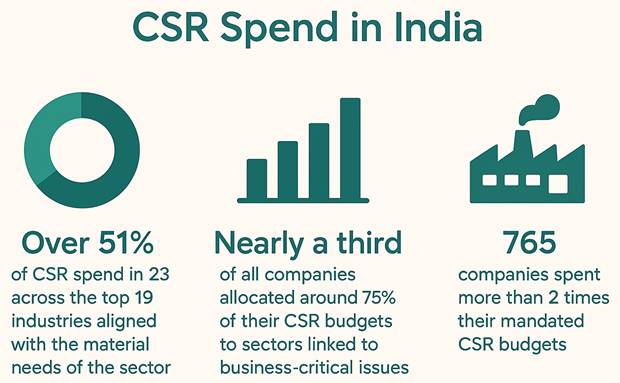
In India, with over 51% of CSR spend aligned to material-sector needs, the trend indicates that Indian companies are moving away from generic philanthropy toward more strategic CSR. Industry-specific risks, social externalities, and value-chain impacts increasingly inform spending.
Source: CSR’s Next Act, State of CSR Report (7th Edition)
Global CSI trends – slow shift, greater strategy
Rockey noted that education received the majority of CSI funding in 2024/25, at 44% of total spend, with minor sectoral shifts from year to year.
Companies continue to balance legacy programmes with more strategic, innovation-oriented approaches, moving from what Trialogue terms ‘CSI 2.0’ to ‘CSI 3.0’. There is a greater focus on professionalism, innovation, and testing new approaches, as well as a more advanced use and application of monitoring and evaluation (M&E).
In India, Mohan noted that it has been 10 years since the Corporate Social Responsibility law was enacted, mandating that companies spend at least 2% of their average net profit after tax on CSR. Giving is growing annually, with R3.5 billion having been invested over the last decade.
Although the early years centred on compliance, companies are now interested in blended capital, investing in climate innovation, and complementing government spending. “There is a greater CSI focus in aspirational districts, which are aggressively pursuing development,” Mohan noted. Nonprofits were the primary beneficiaries, but funding is now also shared with academic and scientific institutions investing in grassroots innovation.
In Brazil, Loyola noted that 2025 saw the highest level of corporate giving in the country’s history. Both emergency responses to regional floods and stable corporate financial performance drove the 20% increase.
Direct cash investments remain the primary vehicle, with non-cash giving less important. Tax incentives ensured a higher volume of direct cash giving, according to Loyola. Different regions require different sectoral allocations, but there is a general push to invest in skills, jobs, and inclusive growth. Almost 80% of companies collaborate with other stakeholders, focusing on common causes rather than territories as such.
Regulatory environments and their influence
South Africa’s CSI landscape continues to be shaped by the Broad-Based Black Economic Empowerment (BBBEE) codes, which incentivise social and economic development, though they don’t prescribe how funds are spent. “Large companies want to get full points for their SED scorecards,” Rockey pointed out.
Loyola emphasised that, while there is a robust regulatory framework and tax incentives to direct spending in Brazil, much funding goes unused due to limited awareness. In addition, companies are mandated to invest in infrastructure in territories to secure a licence to operate. Focusing on this, rather than the quality of programming, can minimise social impact.
Mohan highlighted the challenges of making corporate social investment more outcomes-focused – for example, using blended finance to innovate, focusing on multi-year initiatives, or expanding into vulnerable regions that receive less funding.
Understanding funding dynamics
The panellists discussed how nonprofits can build strong partnerships with funders.
Rockey said companies are allocating more funding to fewer organisations. This means implementers must become “true partners” to the organisation, with trust a vital component. Nonprofits should respond to a company’s strategy and “pain points” and consider what value they can bring to a company rather than pitch “at the front door” and risk rejection.
In Brazil, a notable growth in intermediary organisations is helping overloaded nonprofits access funding and meet compliance demands, particularly for grassroots organisations.
Finally, in India, ‘matchmaking’ platforms have not succeeded. “It’s personal connections between nonprofits and funders that work,” said Mohan, adding that nonprofits are building visibility through thought leadership. Sattva has recommended that companies issue structured requests for proposals (RFPs) to identify new nonprofits with which to work, including social enterprises.
Aid cuts – domestic resilience amid shifts in development funding
Aid reductions in 2025 had an uneven effect: in South Africa, around 15% of nonprofits surveyed reported income losses and programme closures, and around 10% of companies increased healthcare spending to fill some of the gaps, resulting in a 2% increase from 2024/5.
Loyola said Brazil was affected, but companies have increasingly collaborated with civil society and the government to strengthen corporate philanthropy, focusing on “systemic and integrated solutions’’. That said, she expects 2026 to be a challenging year, with businesses adopting a ‘wait-and-see’ approach amid geopolitical uncertainty.
India showed the strongest resilience, with 75% of private development contributions coming from domestic sources, including CSR and family philanthropy. This has fostered greater nonprofit resilience. However, the pressure on India to create jobs and small businesses has been significant, driven by its ambition to become the world’s third-largest economy, and a decline in funding has hurt the country in this regard.
The panellists observed that across all regions, companies have been increasing their investments in health and social services, particularly in areas where public systems are strained. They pointed to a future in which CSI can blend innovation, collaboration, and new financial structures to extend its impact, particularly in underserved communities.
What to expect in 2026
Technological innovation has enormous potential. “Innovating, testing solutions and using CSI programmes to learn and share can influence a much broader space,” said Rockey. In Brazil, artificial intelligence (AI) is beginning to support corporate giving, though adoption remains uneven and requires greater investment to keep pace with innovation in more developed economies.
In India, nonprofits are attempting to use AI in a way that “doesn’t further discriminate or cause inequality”, said Mohan. Local languages are still underrepresented in large language models (LLMs), but a tech startup is paying rural women to provide hundreds of hours of voice data in a local dialect to address this. AI is also being deployed in education to customise learning. These are all promising developments.
The panellists outlined other trends for 2026. Loyola warned that inequality is a challenge in both Brazil and South Africa, and it “acts as a catalyst for political polarisation, social instability and the erosion of trust in institutions”. Corporate investment can play a strategic role in building solutions that can strengthen local capability. “We need to collaborate to reduce vulnerabilities in our countries that fuel social instability,” she said.
Mohan described India’s CSI landscape as being at a crossroads, moving from individual projects toward system-level solutions, underpinned by long-term capacity building and innovative capital. Climate, livelihoods and sustainability will be most prominent in 2026, alongside education.
Rockey emphasised he would like to see more examples of innovation, out-of-the-box thinking and shared learning across the sector. “It’s a complex developmental world we operate in, and the CSI and nonprofit space offers such potential in terms of solving these issues. We’d like to see more organisations being curious about how they can be effective, effect change, get involved and share learnings – it’s a wonderful opportunity,” he concluded.
Key takeaways:
- CSI is becoming more strategic, innovative, and partnership-driven across South Africa, India and Brazil.
- Regulatory frameworks strongly shape behaviour, but quality, intentionality and innovation are emerging across contexts.
- Funding dynamics are shifting: long-term partnerships are replacing short-term grantmaking.
- Aid volatility highlights the importance of domestic development ecosystems.
- Collaborative financing and AI-driven solutions present significant opportunities for scale – with caution around equity and capability gaps.
- 2026 will require strong cross-sector collaboration to address complex global risks.
Watch the full webinar
Find out more
- Explore the company Social Investment topic on the Trialogue Knowledge Hub.
- Learn more about Trialogue’s Strategic CSI Award, which recognises projects that exemplify best practice in strategic CSI in South Africa.
- Explore Resources for nonprofits on the Trialogue Knowledge Hub.
- Discover the latest trends in CSI expenditure in the Trialogue Business in Society Handbook 2025.
- Read about company giving trends in Brazil, South Africa and the United States on the Trialogue Knowledge Hub.
