Few would argue against the merits of pursuing sustainable business, least of all shareholders who stand to gain from long-term value creation. Yet, over the past decade or so, the concept of business sustainability has been treated as non-essential − or worse, as an added cost to creating shared value. In reality, sustainability should be business as usual. Nick Rockey, Managing Director of Trialogue, reviews the journey of sustainability and makes the case for a structured, intuitive approach to adopting sustainable business practice.
From image management to business imperative
For much of the past two decades, corporate sustainability – an approach to business that pursues financial objectives while also strengthening environmental stewardship, social wellbeing and economic resilience – was treated primarily as a reputation-management tool. It was framed as something to be reported on, awarded for and, where convenient, marketed. However, as social and environmental pressures mount, that framing no longer holds. The impact that companies have on the world, and that the world has on them, is increasingly material to a company’s enterprise value.
Corporate governance failures show how quickly irresponsible stewardship can erode corporate value. Sustainability has become a strategic business imperative that requires navigating complex operating environments, managing material risks and opportunities, and securing long-term competitiveness.
This is not the same as ‘doing the right thing’, though it often aligns with that. Rather, it is now framed as a hard-edged business proposition. Companies that manage their sustainability considerations effectively tend to be more resilient, more agile in managing risks and exploiting opportunities, better capitalised and more trusted. Those that do not face growing exposure to legal, regulatory, reputational and financing penalties. The evidence base is now substantial enough to have changed the conversation in the boardroom rather than only in the sustainability office.
The principle holds even in today’s political climate, where the environmental, social and governance (ESG) concept has been challenged. This has resulted in a degree of ‘green-hushing’, where companies deliberately communicate less about their sustainability commitments to avoid scrutiny. Fortunately, ‘green-hushing’ does not appear to be the dominant trend. A 2026 longitudinal study of 75 multinational companies by Cooper and Hawkins at Harvard University found that only 10% of companies had retreated from their climate commitments. By contrast, companies reinforcing their commitments were 46% and the balance exhibited no material change. It is the task of executives to understand this shifting landscape, resist performative retreat and recommit to visible, integrated, credible sustainability action that delivers competitive advantage.
The problem is that most organisations still find it difficult to translate intention into action, particularly at board level, where decisions about strategy, trade-offs, risk and long-term value are made.
A growing emphasis on codes and standards
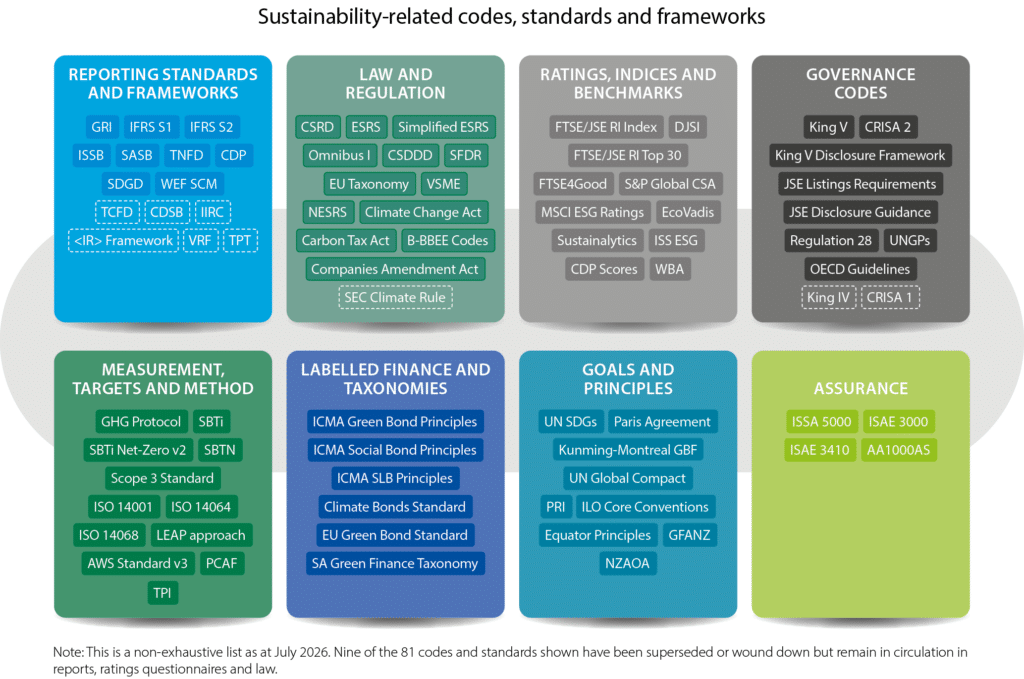
Business plays a decisive role in shaping global social and environmental conditions. Over the past 25 years, international and regional agencies have responded by building an entire architecture of codes, standards and reporting guidelines to channel this influence.
Socially responsible investing emerged in the 1960s, but it lacked any consistent way to measure performance. That changed in 1997, when investors and environmentalists launched the Global Reporting Initiative (GRI) in the wake of the Exxon Valdez oil spill, creating one of the first mechanisms to hold companies to account for their conduct. The term ‘ESG’ itself was introduced by the United Nations Global Compact’s Who Cares Wins report in 2004 and embedded in the Principles for Responsible Investment (PRI) in 2006. South Africa was an early responder to these moves. The Johannesburg Stock Exchange (JSE) launched the first emerging-market Socially Responsible Investment Index in 2004. This was later succeeded by the FTSE/JSE Responsible Investment Index, alongside adoption of the influential King reports on corporate governance.
Rapid institutionalisation followed. Codes and standards proliferated, with the introduction of standards for a wide range of applications covering investor-focused reporting and disclosure, regional standards applicable to certain jurisdictions, and thematic and assurance standards. In South Africa, listed companies are bound by the JSE Listings Requirements, including compliance with the King Code, as outlined in the King IVTM Report on Corporate Governance for South Africa, which emphasises the link between corporate governance and sustainability. Asset managers and owners subscribe to the Code for Responsible Investing in South Africa (CRISA) and the JSE has issued its own sustainability disclosure guidance for reporting, referencing double materiality as a process.
The proliferation of codes and standards has made it harder for companies to decide what to adopt and has substantially increased compliance costs and capacity demands. As a result, a degree of fatigue has arisen around the adoption of standards. The business case for adoption is often undervalued, with superficial adoption delivering negligible shifts in business processes.
The imperative to comply with multiple standards has been elevated by reporting awards, ESG ratings and a surge of investor interest in ESG metrics. This has had the effect of ESG being relegated to a communications function rather than a deliberate effort to shift actual business practices in line with the objectives of these codes, standards and frameworks.
Plotting a course for effective sustainability
In the financial world, strategy and action come first, followed by the reporting of results. The world of ESG should be no different. Yet, in practice, reporting and standards adoption have often been used to drive practice from the bottom up, rather than strategy driving practice from the top down.
Trialogue’s advisory work has repeatedly exposed the symptoms of this inversion. Companies adopt codes and standards without a clear business rationale; elegant business-model diagrams play no part in actual planning and committees report on matters of little relevance. At times, award-winning reports have masked corporate malfeasance. Cases such as Steinhoff and Tongaat-Hulett, where reporting failed to uncover gross overstatements and executive manipulation, remind us how far polished disclosure can drift from reality.
Recognising the inherent flaw in ESG driven by reporting rather than strategy, Trialogue developed an integrated thinking framework to describe the process required for proper embedment of sustainability, where ESG principles are integrated into every core organisational function.
The framework’s logic is deliberately simple. Integrated thinking flows from an understanding of the operating context and the material impacts a business has on society. This understanding is supported by a leadership mandated to invest and respond responsibly, systems and structures that build accountability, metrics and action that drive change, and performance that is tracked and managed. Communication and reporting then become the outcome of sustainability integration, rather than its starting point. Codes, standards and reporting processes play a critical role in enabling effective sustainability practice, but they remain enabling mechanisms rather than outcomes in themselves.
A model for embedding sustainable business practice
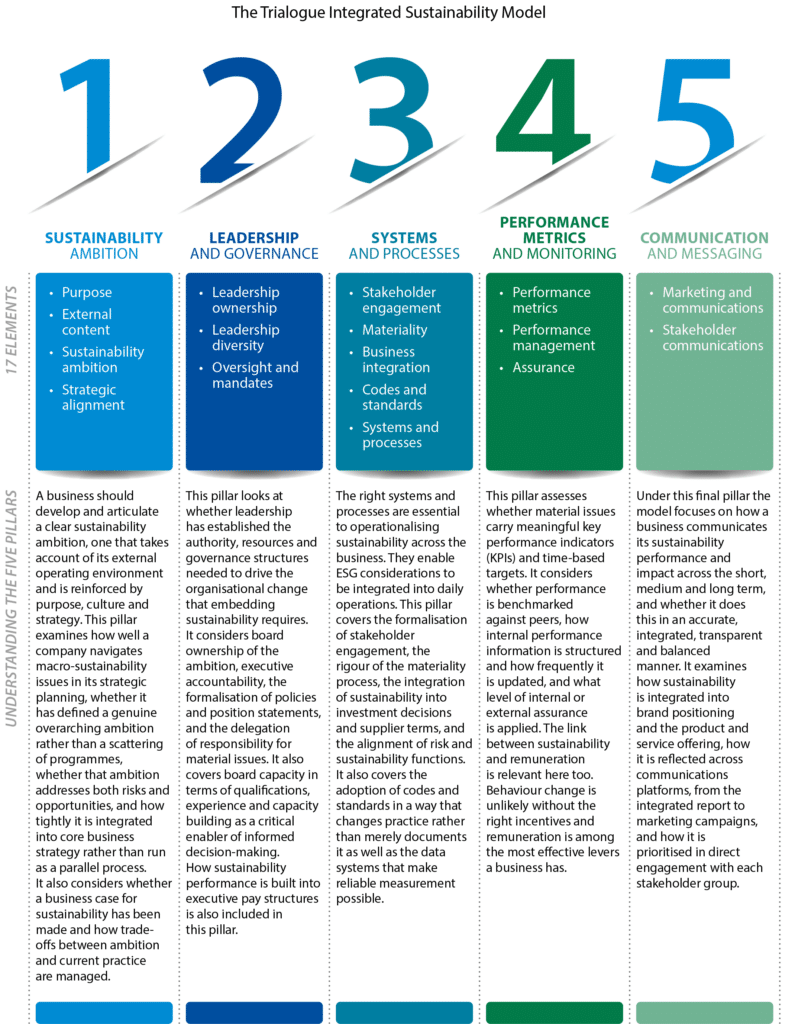
To give an operational blueprint to its integrated thinking framework, Trialogue developed the Integrated Sustainability Model, a process model that assesses the maturity of sustainable business adoption across 5 pillars, 17 elements and 44 indicators. It aligns with the principles and management processes of other leading sustainability standards and frameworks. However, it fundamentally differs from them in that it does not produce a disclosure profile fit for public reporting. Instead, it provides an honest, holistic, internal assessment of how deeply sustainable business practice has been embedded within an organisation.
The five pillars follow the integrated thinking sequence: sustainability ambition, leadership and governance, systems and processes, performance metrics and monitoring, and communication and messaging.
Together, these pillars describe how a business can effectively create holistic, long-term value for itself and its stakeholders. It also reveals where the gaps between strategy and execution remain.
The model underpins an assessment framework, delivered as an online structured self-assessment instrument. It has been used to gauge the maturity of sustainable business adoption among a sample of South African companies. The instrument is deliberately designed around honest reflection rather than scoring to showcase performance. With no right or wrong answers, its value lies in a considered account of where an organisation genuinely stands at the point of assessment.
Putting the model to work
The true value of the model lies in its application. It allows an organisation to do the following:
- Assess its current level of sustainable business practice across all five pillars, providing an honest internal benchmark rather than a curated external narrative. This positioning can be compared with other companies, situating the organisation on the broader maturity curve.
- Identify where sustainability-led practice is already being achieved and where progress is still required. This can lead to the creation of a sustainability roadmap that identifies quick wins and plans for longer-term sustainability imperatives. It can also provide the basis to track annual progress and prioritise capacity and resource allocation.
A review of integrated sustainability maturity tends to reflect on a bell curve. While a small number of boards treat sustainability as a core strategic driver, a similarly small number aim only for base-level compliance. Most sit somewhere in between, with sporadic integration of sustainability into their business practices that show varying degrees of success. The response of executive teams also varies, with some passionately driving a sustainability agenda and others reluctantly making the minimum effort. Knowing where one’s organisation sits on the curve is the first step towards moving to the positive side of the curve.
Embedding sustainability as business as usual is not a quick process. Integrated thinking may be conceptually simple, but its implementation is complex and time-consuming, with trade-offs demanding board-level debate. Despite the complexity involved, the integrated sustainability end-goal is worthy of pursuit. The companies that endure will be distinguished, in the end, by their values, their willingness to confront difficult trade-offs and the depth of their board-level decision-making. Providers of capital, regulators, customers and employees are well-equipped to distinguish operational action from marketing spin and organisations that fail to integrate sustainability into the way they run their business will ultimately pay the price.