

The 2024 Teacher Preferences and Job Satisfaction in South Africa report paints a bleak picture of the sector. Fifty percent of South African educators surveyed said they were considering leaving the profession – 35% of those due to overwork, 34% due to insufficient pay, and 33% due to heavy administrative burdens. Teachers in high-fee schools feel more pressure than their peers in low-fee schools.
This doesn’t augur well for a sector where teacher burnout is a reality, but more teachers are needed to replace those who are retiring.
In October, Trialogue hosted a webinar, in partnership with Telkom, to explore ways in which companies and nonprofits can support teachers through mentorship and continuous professional development. The panellists were Danny Mathebula (Project Manager: ICT Integration at the Telkom Foundation), Omashani Naidoo (Executive Director of SchoolNet South Africa) and Giles Gillett (Chief Executive Officer, National Association of Social Change Entities in Education (NASCEE).
Trialogue research on corporate social investment in education
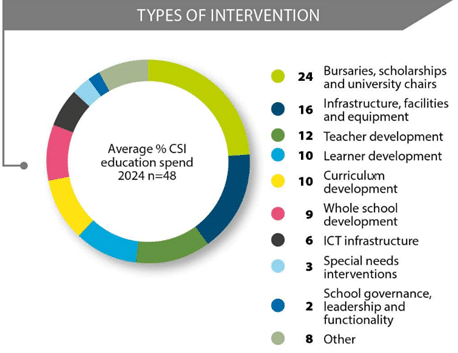
In 2024, education received an average of 45% of total CSI expenditure, with 92% of companies surveyed supporting education (up from 78% in 2023). However, teacher development receives only 12% of CSI spend, slightly more than learner development at 10%.
The Telkom Foundation’s approach to teacher development
Telkom has supported education for many years, and the Telkom Foundations’ holistic approach to teacher development is rooted in the ‘triangle of education’ – the learner, parent, and teacher – and in the collaborative relationships among them, according to Mathebula. The process is driven by the Department of Basic Education, the custodian of education in South Africa, which identifies the skills required by new cohorts. Alignment begins with openness to collaboration and an understanding of beneficiaries’ needs, Mathebula pointed out.
“We must understand programmes and engage often to identify what’s needed on the ground and improve over time, so we don’t short-change funders or institutions,” he said. “Teachers must acknowledge gaps and open themselves to assistance, embracing coaching and mentorship.”
While the Foundation provides teachers with laptops, mobile data and zero-rated access to online content, it also focuses on ICT integration to ensure that technology is a tool rather than a barrier, as it is still considered “taboo” for some educators. Mathebula emphasised the importance of having champions – experienced teachers who lead and mentor new teachers in effectively utilising technology. He added that the Telkom Foundation doesn’t see technology as a simple fix; instead, it invests strategically, starting with feasibility studies to understand infrastructure gaps in rural areas, ensuring stable networks and tailored ICT support for each school.
The Foundation doesn’t only provide resources – it focuses on leadership development and fosters collaboration through communities of practice. It also provides much-needed psychosocial support to both teachers and learners. Working through districts, Telkom identifies school challenges and places two specialists – a social worker and a psychosocial support expert – who can refer cases to the Department of Social Development. This ensures support for both learners and teachers within the triangle of education.
“We don’t force this on teachers, but we make sure they can access it if they need it,” Mathebula pointed out, adding that this helps to create a more enabling environment for teaching and learning. Telkom also zero-rates toll-free numbers, such as Lifeline and Childline, allowing families to access help without incurring airtime or data costs. This initiative aims to create a schooling environment that is free, accessible, and conducive to teaching and learning.
Telkom tracks results through built-in monitoring and evaluation (M&E) at every stage of its programmes. When they train teachers, for example, they continuously assess progress, measuring how many teachers and learners are reached, how confident teachers feel using technology after training, and whether they’re actually applying it in the classroom. This helps Telkom and its investors see whether their interventions are making a real impact.
SchoolNet South Africa’s digital education strategy
SchoolNet is a nonprofit public benefit company that believes that, when paired with the right teacher, technology can be a powerful lever for change, according to Naidoo.
“Digital learning is not just about hardware – it’s about designing how teachers teach and learn,” she said, adding that SchoolNet works primarily in under-resourced schools, and applies a cognitive apprenticeship model that scaffolds learning to create confident, independent teachers who can use digital tools effectively. SchoolNet’s teacher development programmes, aligned with national policy frameworks, serve as “levers for change” and, when used effectively, can help alleviate the stress on overworked teachers. “We want enquiry-based teaching, gamification, and project-based learning, but we must be mindful of teachers’ constraints,” Naidoo explained.
She noted that one of the first positive outcomes SchoolNet sees is that teachers gain confidence in using technology for teaching and learning. For many years, classrooms didn’t change much in how lessons were taught, but digital tools are now helping teachers engage more actively. For example, a geography teacher can use Google Earth to show real-time soil erosion in the Drakensberg, while a life sciences teacher can move beyond static textbook diagrams to interactive renderings of a functioning heart, even utilising AI-based visuals. “These tools help teachers rethink how and what they teach, making lessons more engaging and relevant for learners,” said Naidoo.
NASCEE’s systemic approach to teacher development and collaborative solutions
NASCEE, a national body of education stakeholders, provides the government with a platform to engage civil society. A key focus is teacher development, where mentoring and coaching new teachers are vital for integrating new skills with real classroom experience. When planning interventions, the question is whether they should be local or systemic in nature. Local efforts help a few schools, but systemic solutions embed change and make it sustainable. Another consideration is whether programmes target pre-service or in-service teachers. With 66 000 teachers in training at UNISA – over half of the country’s total – improving UNISA’s programmes is critical.
Systemic change also requires capacitating districts, which are underutilised in our thinking about teacher development, and training district officials to become coaches would make the model more sustainable. However, CSI-funded courses can be costly and not necessarily scalable, which means mentoring and coaching may remain at the local level unless the government is involved. “The scale of the model could be replicated at a cost covered by the state,” Gilette pointed out, adding that it’s encouraging that there’s ample evidence that local coaching is working. He drew attention to best practices in the sector – the Department of Basic Education’s Early Grade Reading Study, which identified instructional coaching as key to improving teacher skills, and the Teacher Internship Collaboration South Africa, a good example of effective sector collaboration for pre-service teacher development.
Support extends to ECD teachers, but this should fit into the broader professionalisation of the teaching sector, Gillette noted. This entails registration with the South African Council for Educators, which has a strategic plan for the profession, and ensuring ongoing professional development for teachers. Like Naidoo, Gillette stated that EdTech is effective but not a ‘silver bullet’, as a lack of connectivity and devices can prevent teachers from accessing it. Additionally, the wide range of options available to teachers makes it challenging to choose, necessitating a verification system to ensure accuracy and reliability. However, he acknowledged that EdTech can “start to level the playing field”.
Digital change management
Digital innovation offers significant advantages for teachers – but not all of them are equipped to handle the shift.
Naidoo said teachers no longer rely solely on textbooks and are now using digital tools, such as Intel Teach, to plan lessons, design assessments, and manage administration. However, one of the challenges has been building trust in under-resourced schools, as there is a “fear around technology” and low confidence, with teachers also unsure of their expectations. However, SchoolNet’s multiple delivery models and follow-up support help address issues related to access, expectations, and comfort levels with hybrid and online courses.
Gillette noted that innovators in teacher development hope that chatbots and AI coaches will provide easy-to-access support, alongside mentorship and internship opportunities. “Change management around using this tech is essential, however, especially since classrooms are not easily accessible in rural areas,” he pointed out. “Still, there’s an opportunity for large-scale teacher training and support.”
Improved collaboration among nonprofits
Gillette said collaboration among nonprofits works best when funders make it a formal part of their impact goals. When funding supports coordination and accountability, and someone is tasked with “holding the centre,” organisations are far more willing to share knowledge, tools, and best practices. However, when collaboration isn’t funded and one organisation tries to lead with limited support, it usually runs out of momentum, he noted.
While nonprofits do compete for funding, funders are increasingly encouraging them to align with government priorities and work together. New models, such as the FLOAT literacy initiative, encourage collective proposals that address shared problems. This means organisations should think more strategically about who they can partner with to strengthen their programmes – for example, a literacy NGO teaming up with one focused on school leadership or teacher coaching.
Tips for companies
The panellists provided final insights on how companies can better support teachers.
Naidoo warned against isolated tech donations, which lead to “quick wins and photo ops” but don’t solve the bigger challenges teachers face. She suggested that embedding coaching and mentorship into school structures will make it easier to identify the “value of change” that tech brings about. Nonprofits in education must also understand policy drivers and change frameworks, rather than merely promoting attendance of workshops for the sake of it. “We have fabulous national frameworks and policies, but often don’t know how to implement them, so we need to think more deeply about the change we’re trying to achieve,” she concluded.
Gillette reiterated that nonprofits could collaborate to improve products and overall impact, whether in coaching or pedagogical support, and challenged funders to finance collaboration, not just programmes, since organisations can’t do this without funding. Mathebula agreed and added that funders should partner with “credible nonprofits focused on impact” so initiatives will benefit the end users.
Watch the full webinar
Learn more
- Explore the Teacher Development topic on the Trialogue Knowledge Hub
