

London Climate Action Week (LCAW) took place from 21 to 29 June, with ‘Climate collaboration in a fragmented world’ as the focus for the week’s agenda. The 7th edition of LCAW convened more than 700 events in an agenda aimed at demonstrating how climate priorities are evolving across business, finance and policy, and at shaping global conversations on climate action.
Topics covered ranged from energy security and industrial policy to artificial intelligence and climate finance, showcasing new approaches to advance solutions that align global finance with nature, climate and people.
With over 45 000 people participating in the events and discussions throughout the week, several key themes emerged:
- Pathways to achieve energy security are needed in a volatile world
- Financial system stability risks and climate adaptation are urgent
- Building business resilience through climate action is a core business issue
- The focus must shift from ambition to implementation and delivery
- Access to finance, innovation and AI are shaping the practical agenda
Pathways to achieve energy security in a volatile world
Noting that the world is currently in its third energy crisis of the decade, discussions pointed to the increasingly urgent need to focus on scaling up grids, mobilising finance and coordinating policy to accelerate the deployment of renewable-powered electricity systems.
This is the face of forecast growing energy needs, including private-sector demand for reliable, clean power and energy resource planning to power AI-enabled activities. While many speakers stressed the need for investment in grids and power systems, the mobilisation pathway of adequate capital flows to finance the investment is less clear.
Financial system stability risks: climate adaptation is urgent
Evident not only from the record-breaking heat in London during LCAW but also from the continued release of reports warning about the potential insurability crisis climate change could create across the financial system, discussions focused on the growing connection between banks and insurers as the insurance sector faces the consequences of the growing protection gap following the catastrophic climate-related weather and nature events of the past few decades.
Commentators noted that policymakers and financial institutions need to recognise that adaptation is no longer a future issue. Conversations stressed the importance of public-private collaboration to create an effective enabling policy environment that will incentivise finance for scaled climate adaptation solutions and nature conservation and restoration.
Discussions explored how public policy, supervisory approaches and market practices can better align to mobilise private capital and accelerate the transition toward climate-smart and resilient growth. They showcased emerging analytical frameworks, policy approaches and practical experiences related to integrating climate- and nature-related considerations into economic and financial decision-making, with a focus on the role of public financial authorities in supporting resilient and sustainable economies.
Building business resilience through climate action
As climate extremes intensify, economies and their constituent public and private sectors and organisations need to build resilience now, leveraging data and information to help them understand and manage these risks, develop sound adaptation pathways to keep themselves ‘out of harm’s way’, and adopt effective business resilience strategies.
Climate is no longer a topic that can be viewed in conceptual terms as a sort of add-on to strategy. It is increasingly tied to operating performance, stakeholder confidence and long-term sustainability, built on organisations developing and deploying informed, adaptive responses that enable them to adapt successfully in a changing environment.
There was an emphasis on the growing importance of capital allocation and investment strategy in credible transition planning, with a focus on the organisation’s climate- and nature-related business risks and opportunities. In this context, the ability to conduct sound transition planning that leads to practically achievable transition plans is a critical objective and skill set for all organisations, particularly those in sectors with extensive climate risk exposure.
Implementation and delivery
There is rising interest in tools that can improve decision-making, optimise systems and accelerate implementation. Organisations are being asked to extend beyond an expression of their climate ambition, telling their investors and external audiences what they want to achieve, to be able to show how they will fund it, how they will execute and what capabilities they need to make progress at pace.
Access to finance, innovation and AI are shaping the practical agenda
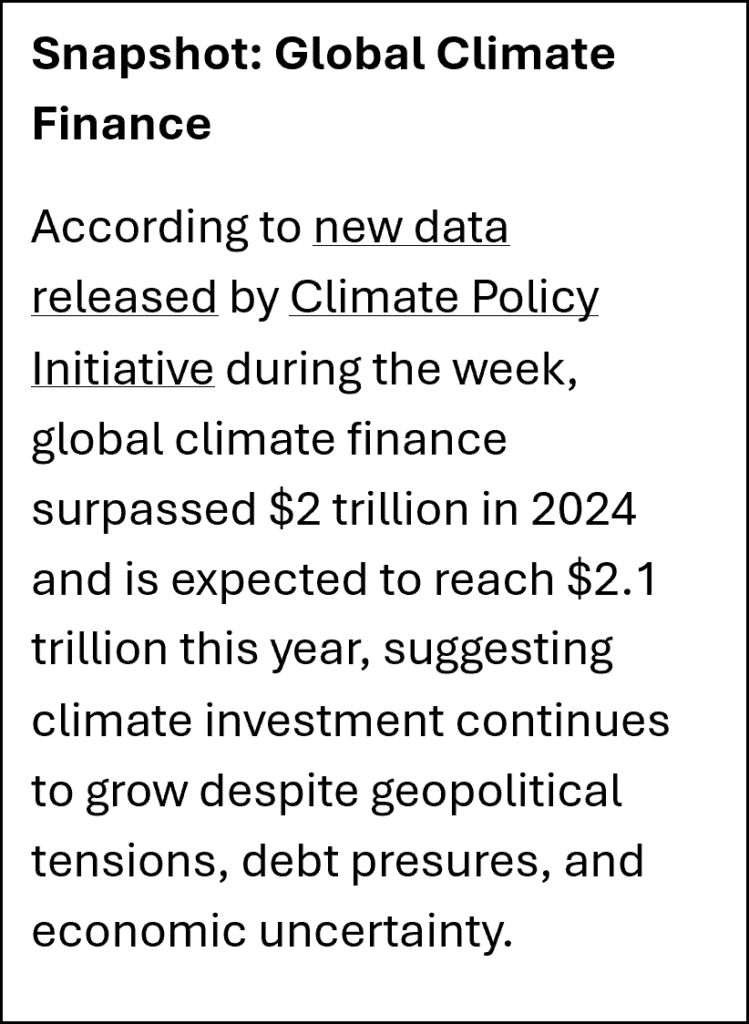
The face of climate finance is broadening as private finance models are activated. It is also maturing, moving from financing commitments to facilitating deal-making.
AI featured strongly throughout the week. There is a need for greater dialogue between the AI and sustainability communities, with many organisations unclear about how to use AI and how it intersects with sustainability. With clear associated risks, including energy demand, pressure on grids and questions of equity, AI technologies support major innovation opportunities that can undoubtedly support the development of effective and efficient climate solutions and assist their scaled deployment across economies
In his opening presentation, UN Secretary-General António Guterres announced the AI Environmental Transparency Initiative, arguing that the environmental footprint of these technologies cannot be ignored: “If AI is to build a better future, it must be honest about what it costs us now”.
While acknowledging that the technology could accelerate the implementation of climate solutions, he called for disclosure of the full environmental impacts of companies’ systems (including energy, water and land use) and a commitment to powering data centres with renewable energy by 2030.
Climate diplomacy
António Guterres, UN Secretary-General, warned governments to address information integrity and urged them to protect “science and truth itself”.
Other prominent Climate Week addresses pointed to fault lines in the support for climate action, with that fragility being exploited by some actors to undermine public climate policies, including by spreading climate misinformation to undermine policies designed to address climate change adaptation measures, from coal phaseouts to renewable energy mandates.
Responding to this risk to maintaining momentum for climate action at scale, the week saw C40 Cities launch the City Climate Facts initiative, which will equip mayors and city planners with tailored advice, scientific backing, and monitoring tools to protect public trust and promote evidence-based climate policies.
Global Climate Finance and the African Continent Dr Rachel Kyte, the UK Government’s Special Representative for Climate, noted in her comments in opening the event: The UK also hosted the replenishment of the Africa Development Fund in December of last year, backing a fund that invests more than half its resources in climate resilience and climate action, because that’s what African countries are asking the international system to do. Our £650m (US$860m) contribution helps leverage up to £1.6bn (US$2bn) in additional grants and concessional loans, including to support climate resilience and adaptation in some of the most vulnerable countries. We are the first African Development Bank shareholder to invest in hybrid capital, helping unlock an additional £250m (US$330m) in lending to African governments. And if we back the President of the African Development backing his vision of how to mobilise domestic financial markets, regional development banks, national development banks and then the African Development Bank, we have an opportunity to support African countries which are not recipients of aid, but African countries who have a vision around green industrialisation, have a vision around manufacturing on the continent because they have access to extraordinary amounts of clean energy and the minerals and metals that are needed for a renewable energy revolution. It is a completely different relationship which we are welcoming and which we want to be part of a reset around. So we have to support innovative ways of multiplying the impact of the systems that we already have, making them react with more urgency, protecting their mandates and protecting their ability to support the Paris Climate Agreement’s mandate.
Contact: Joanne Henstock
