

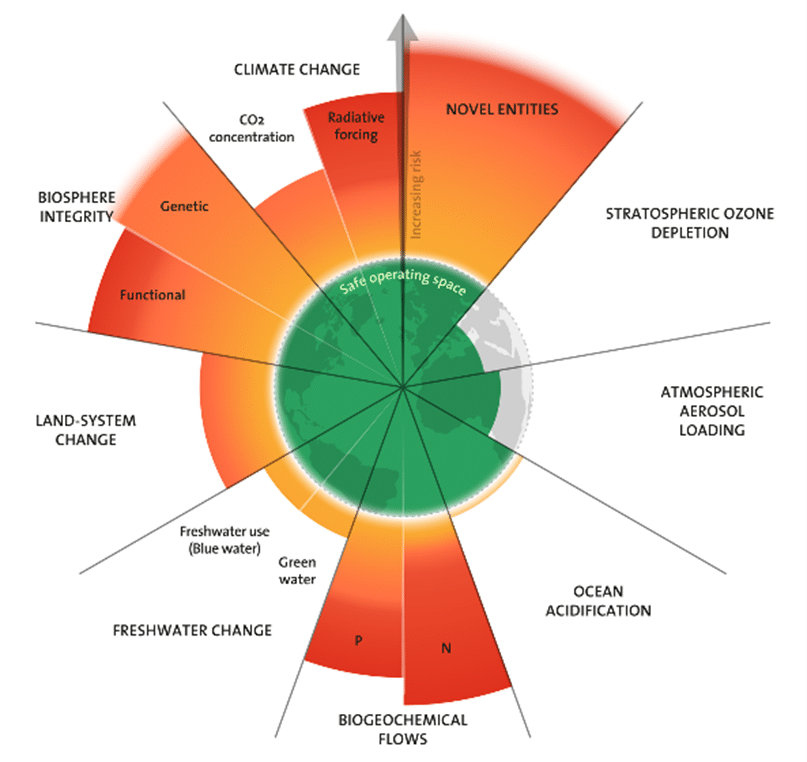
The Planetary Boundaries framework tracks nine Earth-system processes to define a safe operating space for humanity. Planetary boundaries are guardrails set at a prudent distance from dangerous thresholds to keep Earth in a stable and resilient state. Breaching Planetary boundaries increases the probability of self-amplifying feedbacks and tipping points (e.g. ocean system shifts), with potentially irreversible impacts on economies and societies.
The 2025 update now shows seven of nine boundaries breached, with ocean acidification added for the first time, alongside climate change, biodiversity loss, land-use change, freshwater stress, nutrient overload and chemical pollution. Only ozone and aerosol levels remain within safe limits. This signals we are moving further beyond Holocene-era stability and into a high-risk zone for ecological collapse.
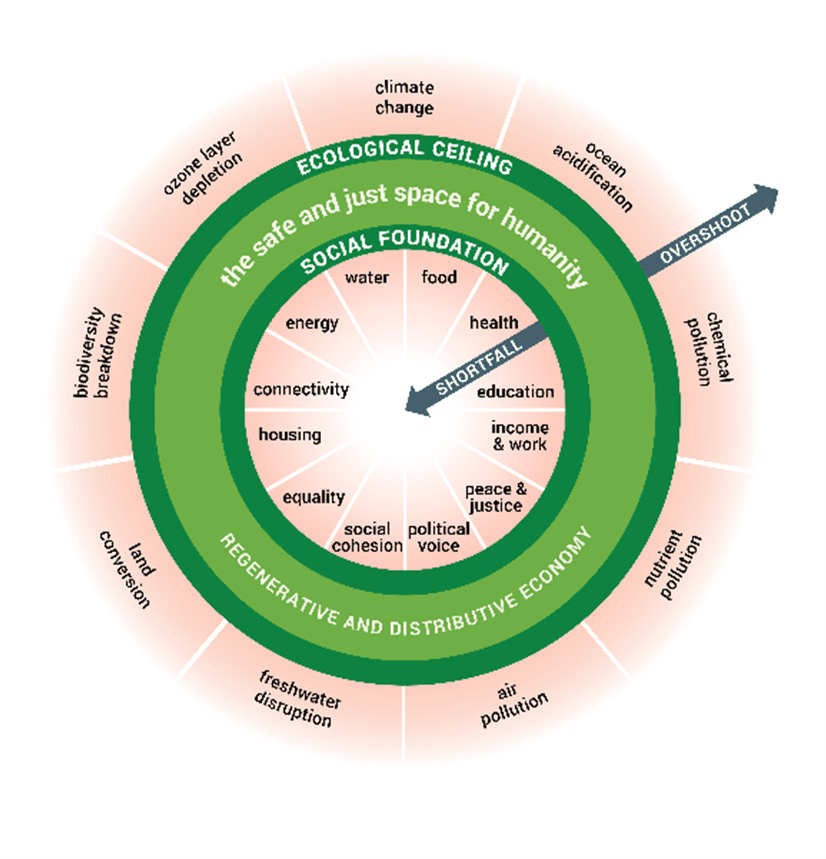
The Doughnut Economics model (3.0) complements this by pairing an ecological ceiling (planetary limits) with a social foundation (basic needs). Its 2025 version reveals the richest 20% of countries are driving most overshoot, while the poorest 40% still fall short on essentials like healthcare, housing and education. Both frameworks confirm humanity is overshooting planetary boundaries while failing to deliver wellbeing for all.
Incremental change is no longer sufficient. Both frameworks call for systemic transformation. Without bold shifts from business-as-usual, the convergence of ecological overshoot and social shortfall will erode long-term resilience.
What does this mean for you?
Positioning your sustainability strategy within the ‘safe and just space’ means aligning business growth with the needs of people and the limits of the planet. This ambition should be set at board level, anchoring long-term value creation in ecological and social resilience. To do this, companies can draw on the planetary boundaries framework to shape targets not only for carbon reduction, but also for freshwater use, land conversion, nutrient runoff and biodiversity. Tools like the Science-Based Targets Network (SBTN) and TNFD can translate global limits into measurable local action.
Investment in sustainable innovation that leverages efficiency, circular design and nature-based solutions is good for the planet, builds resilience, lowers costs and enhances brand trust, too.
South Africa’s forthcoming ESGAP report (led by UCL, the Centre for Sustainability Transitions at Stellenbosch, BC3 and SAIIA) will provide the country’s first science-based assessment of environmental sustainability gaps. For corporates, this may signal where future policy, disclosure norms and investor expectations are headed.
For more information contact David Krone.
