
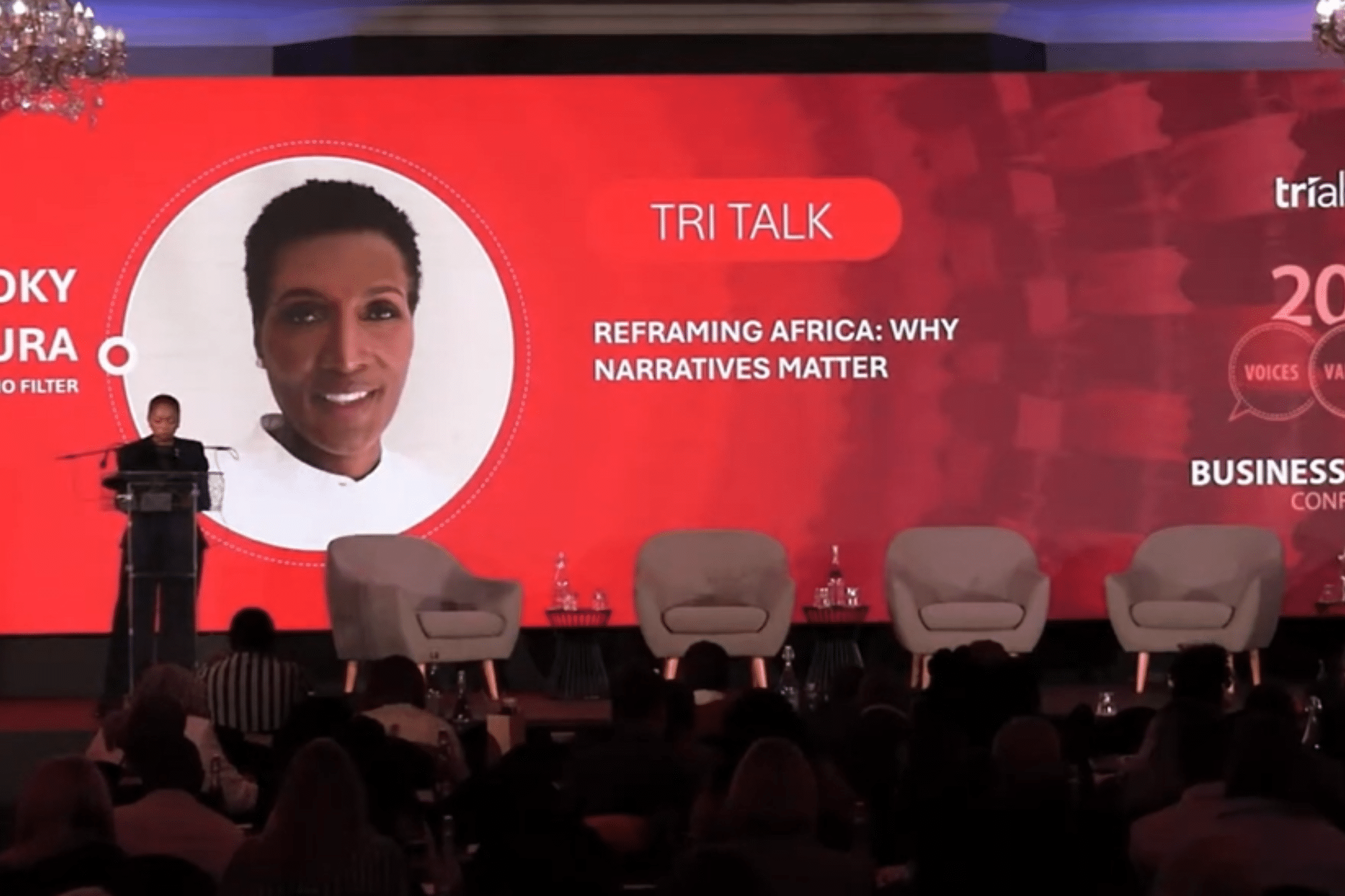
Stories matter because they influence behaviour – and stories told about Africa continue to shape perceptions about the continent, even though they tell only part of the story. It is now time to change the narrative.
This was the message delivered by Moky Makura, Executive Director of Africa No Filter, in her Tri Talk on the first day of the Trialogue Business in Society conference. The “story that is killing Africa” is that of violence and poverty, largely formed by “newspapers and stories from films”, according to a Norwegian businessman with whom Makura had a chance encounter in the UK.
He had never visited Africa, he told her, because he didn’t think he would enjoy the experience.
A narrative that is not neutral
At the heart of Makura’s argument is a persistent framing of Africa as “broken, dependent, somehow lacking”.
Through the Global Media Index, Africa No Filter has tracked how global media covers the continent. Across 20 major international outlets, 70% of stories focus on politics, poverty, corruption and crises, with less than 10% covering innovation, culture, the arts or positive development. In addition, only 27 of the 54 countries across Africa have been covered.
“This narrative is not neutral – it is patterned,” Makura said.
African voices are underrepresented, with interviews mainly featuring political or business elites. The perception, said Makura, is that “we don’t have the agency to create the change we need”.
Real-world consequences
For Makura, this narrative has direct, measurable consequences, one of which is how young Africans see their future on the continent. “Sixty percent of young Africans want to leave and join the diaspora,” she noted.
Even for those who remain, the prevailing narrative shapes aspiration and behaviour, limiting the extent to which the continent is seen as “a place of opportunity”.
Narrative also drives external decision-making. “It influences who stays, who leaves, who invests, and who gets left behind,” Makura pointed out. This is visible in global mobility patterns. “African passports are the most discriminated against,” Makura said, pointing to visa inequality as a structural barrier. Cost, processing times and restrictions all reinforce exclusion.
It is equally visible in capital flows.
“Bad stories are not just harmful but also expensive,” Makura said, citing an estimated US$4.2 billion in costs linked to perceived risk. This includes the “risk premium African countries pay in terms of sovereign debt” – capital that could otherwise fund development priorities.
Higher perceived risk translates directly into higher borrowing costs. While businesses in Europe borrow at roughly 4-8%, African companies often face significantly higher rates. “The risk premium gap means African businesses pay 2-6x more to borrow,” she said.
A visibility gap
Makura situated these perceptions within a longer historical arc, from colonial-era storytelling to the global imagery of Live Aid. This has resulted in an industry to “save Africa”, which continues to influence decision-making today, despite reality having changed.
Africa is a place of opportunity, but this needs to be put across. “It’s not a lack of stories, but a lack of visibility,” Makura noted. At the same time, the systems that shape narrative remain under-resourced. “Media is one of the least-funded industries on the continent,” she said.
For Makura, the response must be deliberate and systemic. The priority is to “tell more and better stories” and to shift from deficit-based framing to “asset and opportunity framing”.
She outlined practical steps for organisations and funders:
- Fund storytelling ecosystems
- Amplify African voices
- Shift to opportunity framing
- Share your story
Central to this effort is the Opportunity Africa movement, launched by Africa No Filter. It is “African-led, practitioner-led, pan-African”, with a dual focus: “for Africans first, the world second”. The aim is not to replace existing initiatives, but to connect and strengthen them and build “one big, coherent story”.
In Makura’s account, narrative is not a soft issue. It is a structural determinant, shaping capital, mobility, policy and belief. And until that story changes, so too will the limits of what the continent can realise. Visit Opportunity Africa to find out more about the initiative.
