

Creating measurement, evaluation and learning (MEL) frameworks for locally led or community-driven development programmes can be complex, as their impact often differs from more traditional approaches. Bridgespan’s report, How to Assess Community-Driven Change: Four Guiding Principles for Funders and Nonprofits, distils insights from funders and nonprofits who use a community-driven change perspective, highlighting four best practices for assessing progress in these programmes.
Community-driven change (CDC) is an approach to development programmes that encourages communities to transition from being passive beneficiaries to becoming active partners, and eventually, to taking ownership of their own development priorities. This method is a departure from traditional ‘top-down’ approaches that impose predefined solutions on communities.
The Bridgespan Group’s 2024 report, Community-Driven Change: Demonstrating Impact in Africa and India, found that CDC is advanced when power and assets as well as equity and inclusion, are strengthened in a community. It also revealed compelling evidence that when funders and nonprofits take a CDC approach in their programmes, it leads to more enduring and equitable change.
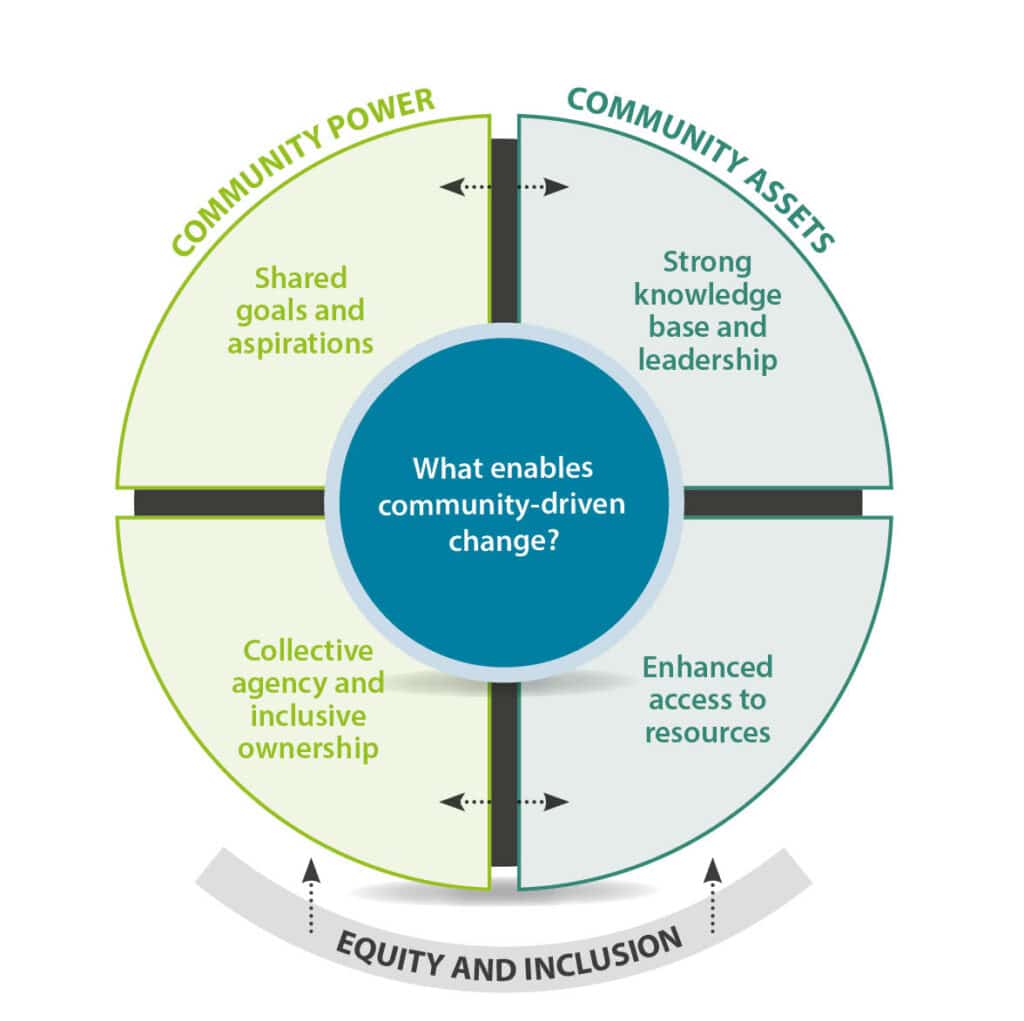
Despite the growing interest in CDC in recent years, there is still persistent uncertainty among funders and nonprofits about how to integrate a CDC approach into their work. In particular, funders and nonprofits are unsure how to track progress and evaluate results when it comes to CDC.
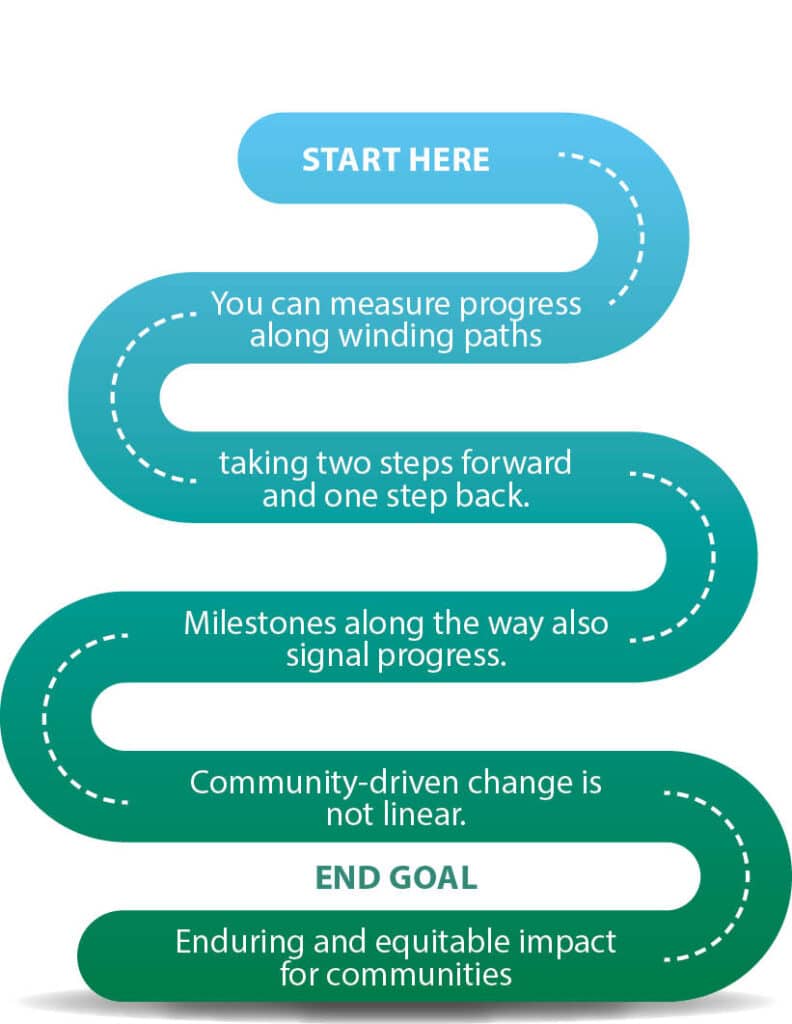
Approaches to measurement for CDC are unconventional because the process of strengthening power, assets and equity and inclusion is rarely captured in traditional measurement approaches, which often assume that progress follows a straight line, typically moving from programme inputs (activities) to outputs (for example, how many schools have been built in the community) to programmatic outcomes (such as doubling the literacy rate in a community). However, CDC is non-linear in its approach. It requires constant adaptation to match the community’s changing needs as it becomes more empowered. That means that missteps and iterations are not just common but an inherent part of the CDC process. It requires patience, since large-scale change takes time.
The CDC report aims to provide insights and actionable resources for assessing progress on CDC without requiring practitioners to overhaul their existing measurement frameworks.
Methodology
Bridgespan interviewed over 50 funders, nonprofits and intermediary organisations in Africa and India who work directly or indirectly with communities to see if and how they integrate a CDC approach in their work and how they measure progress. These insights were validated through group and one-on-one consultations with experts to arrive at a qualitative synthesis of best practices as well as detailed guidance on assessing progress across power, assets and equity and inclusion in a community.
Key findings
Measure what matters to the community
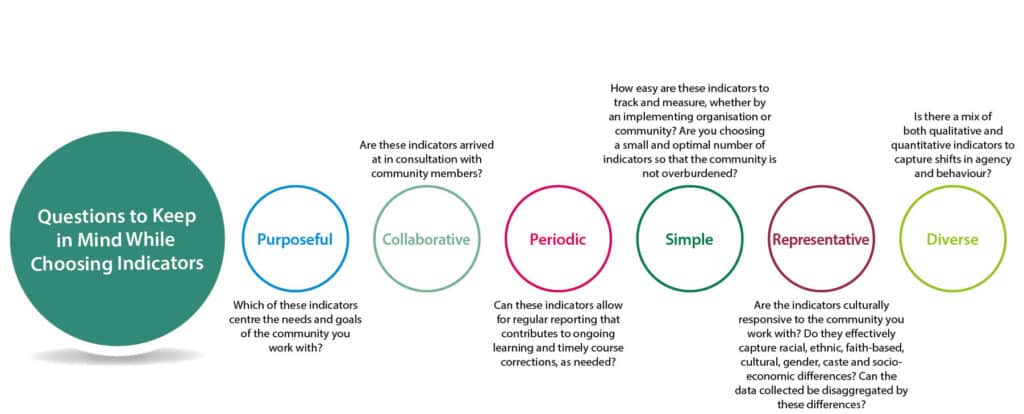
Success metrics should be defined by the community, rather than through a sectoral or programmatic lens. Grounding measurement in the community’s aspirations requires assessment frameworks that are co-created with, and not for, the community. This process may differ depending on the context of the work. It might involve in-depth field visits or hiring staff from the communities they serve who understand and can speak to the community’s lived experience.
Trust is essential throughout this process, especially from funders. Funders learn more when they allow their grantees – those closest to the community’s needs – the freedom to choose which success metrics to track, in consultation with the community. This may include culturally responsive metrics that are meaningful to the community, even if these metrics are considered non-traditional.
Diversify your data
A CDC progress assessment balances quantitative and qualitative data to capture the true extent of a community’s transformation.
During data collection, practitioners balance the breadth (number of respondents) with the depth (richness of responses) of impact. While surveys and interviews may lead to a larger sample size, tools like storytelling help practitioners to better understand outcomes such as co-ownership or agency, which are difficult to track quantitatively.
Diverse data collection calls for varied methods. This approach allows funders to connect with communities in meaningful ways and accommodate indigenous practices of knowledge sharing, such as oral storytelling. Importantly, data collection should not place undue burden on the community.
Community facilitators and MEL teams who are trained in participatory methods can enhance the quality and depth of the information captured.
Make learning central to the process and adapt accordingly
Change is central to assessing CDC progress. As power, assets, equity and inclusion in a community are strengthened, the community’s motivations and aspirations change too. Tracking progress on CDC is most effective when assessment frameworks are adaptable and responsive to keep pace with these changing needs.
Measurement rooted in a culture of learning fits this iterative process well. It is necessary to question what has been achieved, what can be learnt from the information gathered and what adjustments may be needed to better support the community.
This culture of learning encourages continued engagement with the community, keeping members informed of insights gathered throughout the assessment process. This approach builds transparency and accountability, while also providing an opportunity for the community to offer critical feedback.
Measuring to learn requires flexibility, particularly in reporting structures. Data should be good enough to influence decision-making without complex reporting structures that overburden communities and nonprofits.
Allowing time for reflection enables practitioners, internal stakeholders and communities to assess progress and evaluate assumptions.
Recognise that CDC progress is a journey, not a destination
Progress in CDC is non-linear. It requires funders and nonprofits to be comfortable with uncertainty instead of expecting predictable results along a predefined timeline, as is common with more programmatic approaches.
Assessing progress in CDC involves assessing how change happens within the community. This process of change is valuable for achieving the long-term social impact that CDC seeks.
External factors such as regulatory or policy changes, access to markets, or natural calamities can influence large-scale social change. Consequently, attribution is not always possible for CDC. Instead, in the early stages of CDC programmes, practitioners may focus more on process evaluation, emphasising the quality of their activities over outcomes.
Recommendations
The following reflection questions offer a guide to funders and nonprofits developing an impact assessment framework for CDC:
| 1. Does your definition of success align with that of the community you are working with? Does it incorporate the lived experience of the community? |
| 2. What type of data do you plan on capturing to assess progress? How will this data help you and the community learn? |
| 3. Does your data include both qualitative and quantitative metrics? Are your data collection methods inclusive and accessible? |
| 4. How do you plan on moving beyond simply consulting the community to involving them in various steps of the assessment process? |
| 5. How will you incorporate feedback from the community throughout your assessment process? How will you adapt based on this feedback and how will you close the loop with the community? |
| 6. Are your reporting structures flexible enough to accommodate the non-linear nature of CDC? |
| 7. Given the external factors that influence outcomes, how do you assess the standards of evidence that can attribute results to the CDC process? |
| 8. How do you elevate the value of CDC as an ongoing process, not just as a means to an end? |
Find out more
- The full report, How to Assess Community-Driven Change: Four Guiding Principles for Funders and Nonprofits, is available at: https://www.bridgespan.org/insights/measuring-community-driven-change-resources-for-funders-and-nonprofits/how-to-assess-community-driven-change-four-principles
- Contact: The Bridgespan Group | contact@bridgespan.org | www.bridgespan.org
