

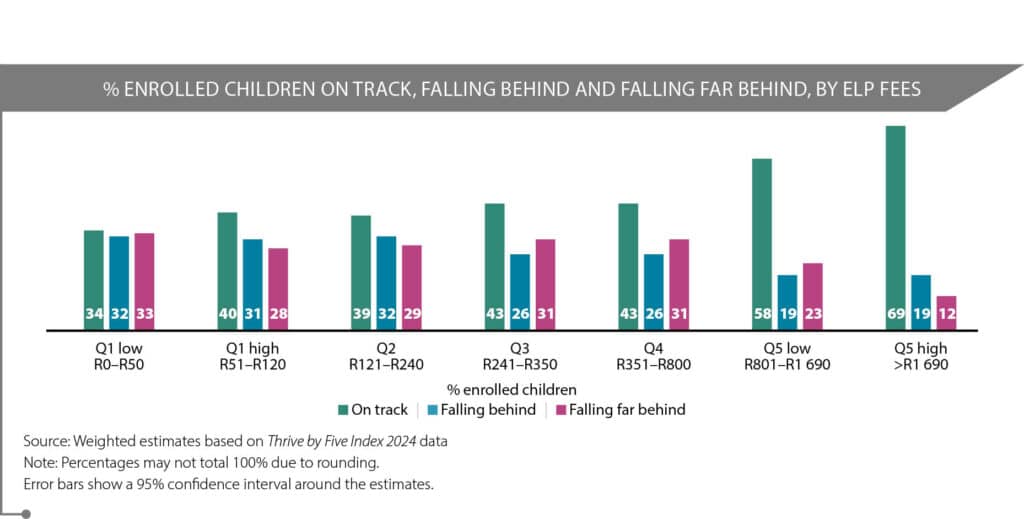
The Thrive by Five Index 2024 offers the most comprehensive picture yet of how well South Africa’s four-year-olds are developing. The findings present a concerning picture: only 42% of children are on track for early learning. Girls fare slightly better than boys, with 48% of girls on track compared to 37% of boys. Children enrolled in higher-fee early learning programmes (ELPs) are twice as likely to be on track compared to those attending the poorest ELPs.
By the time a child turns five, the foundations for lifelong learning, health and wellbeing are already in place. Yet, despite the well-established importance of this early stage of life, South Africa has long lacked reliable national data on whether young children are receiving the care, support and stimulation they need to thrive. Against this backdrop, the Thrive by Five Index was launched in 2021 as a collaborative effort to track and promote early childhood development (ECD) outcomes at a national level.
The Index is designed to provide a clear, regular picture of how young children in South Africa are developing in key domains and how the early learning environment, household conditions and broader social context contribute to this development.
The 2024 Index is the second in a series of cross-sectional, nationally and provincially representative studies to be undertaken every three years. This second edition of the Thrive by Five Index builds on the inaugural 2021 Index, expanding the study’s scope and methodological rigour. It also introduces a substudy of non-enrolled children to shed light on the realities of those children not attending ELPs.
Methodology
The Thrive by Five Index 2024 assessed a nationally and provincially representative sample of 5 001 children enrolled in 1 388 ELPs across all nine provinces. Within each ELP, boys and girls aged 50–59 months were randomly selected. A sub-study of 272 non-enrolled children, purposively selected from low-income areas in three provinces, was also included, though this group is not nationally or provincially representative. The index tracks progress in three core areas of development:
- Children’s early learning, assessed using the Early Learnings Outcomes Measure (ELOM) 4&5 Years Assessment Tool, which covers five developmental domains
- Social-emotional functioning, measured through practitioner ratings for enrolled children and caregiver ratings for non-enrolled children
- Physical growth (stunting), measured by children’s heights using mobile stadiometers
Data collection took place between September and November 2024, with ethical clearance granted by the University of Cape Town’s Faculty of Humanities Ethics Review Committee (Ref: PSY2024-032).
Key findings
Nationally representative enrolled four-year-olds
The overall findings for the nationally representative enrolled sample of four-year-olds found that:
- Less than half of four-year-olds are on track for early learning. Only 42% of children enrolled in ELPs are developmentally on track for early learning. This means fewer than half are starting school with the foundational skills they need to succeed. Emergent literacy and language was the strongest performing domain with 53% of children on track. Fine motor coordination and visual motor integration had the lowest proportion, with only 29% on track.

- Boys are falling furthest behind, except in gross motor skills. Forty-eight percent of girls are on track overall, compared to 37% of boys. This trend is consistent across all developmental domains, except gross motor development, where boys are slightly ahead of girls.
- The poorest children are struggling the most. Children attending the highest-fee ELPs are twice as likely to be on track compared to those in the lowest-fee ELPs.
- Emotional readiness for school falls short. Only 56% of children meet the standard for emotional readiness and 63% meet the standard for social relations. Girls, on average, outperform boys in social-emotional development. Emotional functioning stood out as a strong predictor of learning outcomes.
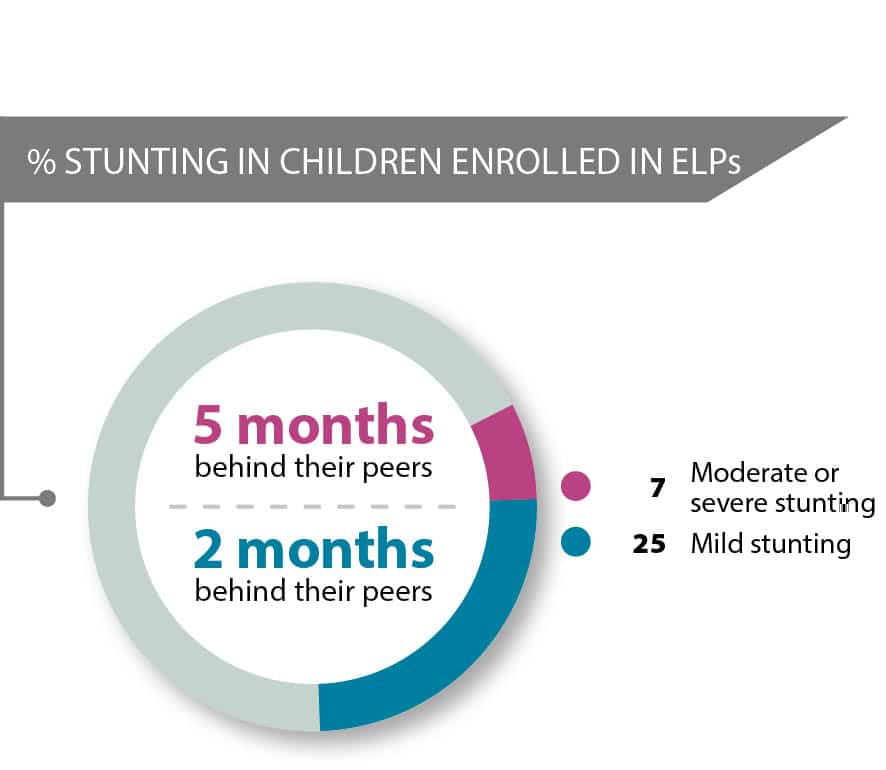
- Stunting sets children back. Some 7% of children are moderately or severely stunted, with 25% showing signs of mild stunting. By age four, moderately and severely stunted children are about five months behind their non-stunted peers in early learning, while mildly stunted children are roughly two months behind.
Non-enrolled sub-sample.
While the sub-sample of non-enrolled children is not statistically representative of the broader provincial or national population, the overall findings for the non-enrolled sub-sample found that:
- Only 18% of the non-enrolled sample are on track for early learning and more than half (55%) are falling far behind.
- When comparing non-enrolled and enrolled children with similar characteristics, non-enrolled children are, on average, five months behind their enrolled peers.
- Boys are especially at risk, with only 14% on track compared to 22% of girls.
- Some 18% on the non-enrolled sample are moderately or severely stunted.

Non-enrolled children from low-income communities are falling far behind, remaining in poverty and food insecurity, missing out on meals, stimulation and health checks offered by ELPs.
Drivers of good early learning
A structural equation modelling (SEM) analysis examined which factors predict differences in children’s early learning performance, as measured on the ELOM 4&5. The analysis identified six factors that together account for 49% of the variation in early learning outcomes in the enrolled sample. The strongest predictor was children’s ability to maintain attention, diligence and interest while working on ELOM 4&5 tasks followed by their emotional functioning and household socioeconomic status.
Case study
SEM analysis in action
Consider a 59-month-old girl from a household with a higher-than-average socioeconomic status. Based on our model, this child is expected to show stronger than average emotional skills. Her age, gender, family resources and emotional strengths together predict better than average attention. These combined advantages result in a predicted ELOM 4&5 score that is well above the average.
Now consider a 50-month-old boy from a household with a lower-than-average socioeconomic status. The model predicts he would show weaker emotional skills and, as a result, have more difficulty with attention. His predicted ELOM 4&5 score would likely fall well below the average.
The difference between these two children represents a wide gap in school readiness, one that could shape their educational journeys.
Recommendations
The 2024 Index offers a clear overview of how young children in South Africa are developing and highlights the most significant gaps, with notable differences based on gender and socioeconomic circumstances. It also shows that some children achieve strong results despite facing disadvantages.
The following are six priority actions that can help change the narrative and build a more equitable early learning system in South Africa.
| 1. The most vulnerable children remain excluded. It is essential to understand and eliminate barriers to access. |
| 2. The sector is under-resourced. Increased and more efficient funding flows are needed at all levels to ensure sustained and quality services. |
| 3. Stunting holds children back. Preventing stunting should involve leveraging ELPs as platforms for delivering nutrition and health services. |
| 4. Emotional functioning shapes learning outcomes. ELP practitioners and caregivers need support to integrate simple, everyday practices into daily routines. |
| 5. More than 50% of children are unprepared for Grade R. Strengthening Grade R as a bridging year is needed to help children catch up. |
| 6. Caregivers need more additional support to enhance their involvement in early learning. |
Find out more
- The full report, Thrive by Five 2024 Index, is available at: https://thrivebyfive.co.za/findings-enrolled-children/
- For more detailed information on priority actions needed, see the Evidence to Action report at: https://thrivebyfive.co.za/wp-content/uploads/2025/09/TB5-RecommendationsBriefEvidencetoAction-FINAL.pdf
- Contact: info@thrivebyfive.co.za
