DEVELOPMENT TOPICS: Housing and living conditions

Around 90% of people in Africa live in informal housing. Although African governments provide housing to some extent, this can be costly and does not necessarily lead to the growth of affordable housing.
Instead, most of Africa’s population live in unsafe conditions, with limited access to drinking water, adequate sanitation and electricity. The housing crisis, partly driven by rapid urbanisation and economic migration, has been worsened by unemployment and poverty. Very few people on the continent can afford formal housing, and banks are strict when it comes to extending mortgages.
Housing drives social inclusion and economic prosperity. People who lack shelter, or who have inadequate housing, are more vulnerable to displacement and violence.
Company support for housing and living conditions
Investing in housing and living conditions can help to ensure the safety and dignity of citizens and safeguard basic needs. It can also improve health outcomes and reduce the spread of infectious diseases, which are difficult to contain in densely populated informal settlements.
Companies can invest by building and maintaining infrastructure, improving water, sanitation, and hygiene (WASH) in communities, and funding sustainable energy initiatives. Such investments foster the development of economic hubs, which can drive employment and improve the quality of life. Affordable housing is a priority in urban centres as it supports social and economic inclusion.
Explore Trialogue’s resources to deepen your understanding of how corporate social investment might support better housing and living conditions.
South African national context
- The national budget allocated to human settlement, and water and electrification programmes decreased from R59.2 billion in 2024/25 to R57.4 billion in 2025/26, continuing a downward trend and constituting 2.2% of consolidated government expenditure of R2.59 trillion.
- According to Stats SA’s General Household Survey 2024, the percentage of households that live in formal dwellings increased from 73% in 2002 to 84% in 2024. Almost 12% of households lived in informal dwellings, and 3.9% in traditional dwellings. The survey also found that while nearly 72% of urban residents have access to safely managed water, only 36% of rural residents do. The percentage of South African households that were connected to the mains electricity supply increased from 76% in 2002 to 90% in 2024.
- The 2024 White Paper for Human Settlements reports that government has delivered 5.2 million housing opportunities since 1994, but there are still more than 3.4 million South Africans on the housing needs register. The rate at which government has been providing housing has declined, meaning it will take longer to meet the housing demand at the current rate of supply. The human settlements backlog manifests as the rise of informal settlements, poor-quality physical environments and limited access to social and economic amenities.
- According to the Department of Human Settlements (DHS), there were 4 297 informal settlements, home to more than two million households, across South Africa in 2023, most of which are in the major metropolitan areas of Johannesburg, Cape Town and eThekwini. The DHS has committed to upgrading 1 500 informal settlements by 2026 and, in total, just over 4 000 by 2029 through the Informal Settlement Upgrading Programme (ISUP).
- In February 2025, Stats SA released its first thematic report on homelessness in South Africa, A Profile of Homeless Persons in South Africa 2022, based on 2022 Census data. The research found that there has been an upward trend in homelessness over the past three decades. The number of homeless persons increased from 13 135 in 1996 to 55 719 in 2022. Children account for approximately 7% of homeless people, while youth (15–34 years) represent 44%.
Overview of CSI spend
Housing and living conditions were supported by 20% of companies and received 2% of average CSI expenditure.
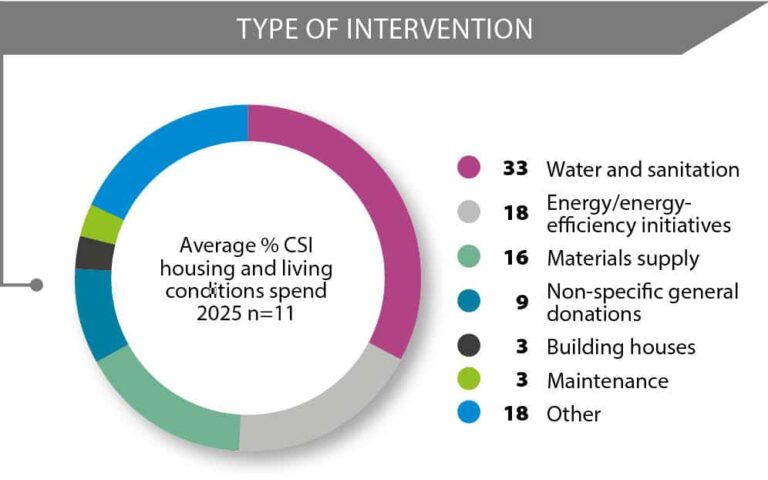
- Average CSI spend on water and sanitation increased from the least supported intervention type in 2024 (11%) to the most supported in 2025, at an average of 33%, though sample numbers were small.
- Support for energy and energy efficiency initiatives also increased, from an average of 14% in 2024 to 18% in 2025.
- In contrast, average sector CSI spend on building houses dropped from the highest in 2024 (31%) to among the least supported in 2025 (3%), alongside maintenance (3%).
- Companies also reported supporting legal assistance and helping facilitate title deed access. Overall, 18% of average CSI allocations went to other intervention types in this sector.