

National context
- Government’s budget for education, learning and culture in 2025/26 is R508 billion, up from R482 billion in 2024/25. This represents 20% of the consolidated national government expenditure bill of R2.59 trillion. Of this, R332 billion (65%) is allocated to basic education, R48 billion to higher education, R14 billion to technical and vocational education and training and R55 billion to the National Student Financial Aid Scheme.
- President Cyril Ramaphosa signed the Basic Education Laws Amendment Bill into law in September 2024. In February 2025, Minister of Basic Education Siviwe Gwarube told Parliament the Act was fully operational. The Act aims to strengthen governance in South Africa’s education sector.
- During his 2025 State of the Nation Address, Ramaphosa announced that government was implementing Phase 1 of the Comprehensive Student Funding Model for Higher Education to address the needs of the ‘missing middle’. An additional 10 000 students were expected to be assisted by the end of the first year in 2025. In 2024, over 900 000 students from poor and working-class backgrounds received funding to study at universities and colleges.
- According to Gwarube, 724 156 out of 1.2 million learners who started Grade 1 in 2013 enrolled as full-time candidates for matric in 2024 (approximately 59%), indicating a high dropout rate and a high rate of learners who did not complete their basic education in 12 years. Of the 705 291 full-time candidates who wrote the 2024 exams, just over 87% passed, an increase of more than four percentage points from 82% in 2023.
- The pit latrines in over 93% of the 3 372 schools identified with them were replaced under the Sanitation Appropriate for Education (SAFE) initiative by March 2025. According to the Department of Basic Education (DBE), infrastructure backlogs remain: 13 655 schools need more toilets, 6 319 lack sustainable water and 8 265 need more classrooms. The DBE estimates that R129 billion is needed to address infrastructure backlogs by 2030.
- Phase 5 of the Basic Education Employment Initiative (BEEI) was launched in June 2025, creating 204 676 job opportunities for youth aged 18–34. Roles include education assistants, general school assistants, ICT eCadres, reading champions and infrastructure handypersons. This phase is funded by R4 billion from the Unemployment Insurance Fund (UIF) and R1.6 billion from National Treasury.
- The Thrive by Five Index 2024 found that only 42% of preschoolers are developmentally on track (see page 239 for more on the Index). The rand value of the early childhood development (ECD) subsidy increased for the first time since 2019, from R17 to R24 per child per day, which ECD systems change nonprofit Ilifa Labantwana estimates covers 66% of the total cost of providing quality early learning programme services.
- Education fees are surveyed annually in March, according to Statistics South Africa (Stats SA). The education price index increased by 4.5% in 2025, below the 6.4% rise in 2024. School fees increased by 5.0% (from 6.6% in 2024). Tertiary education institutions charged 3.7% more in 2025, down from 5.9% in 2024.
Overview of CSI spend
Education was supported by 91% of companies and received 44% of average CSI expenditure.
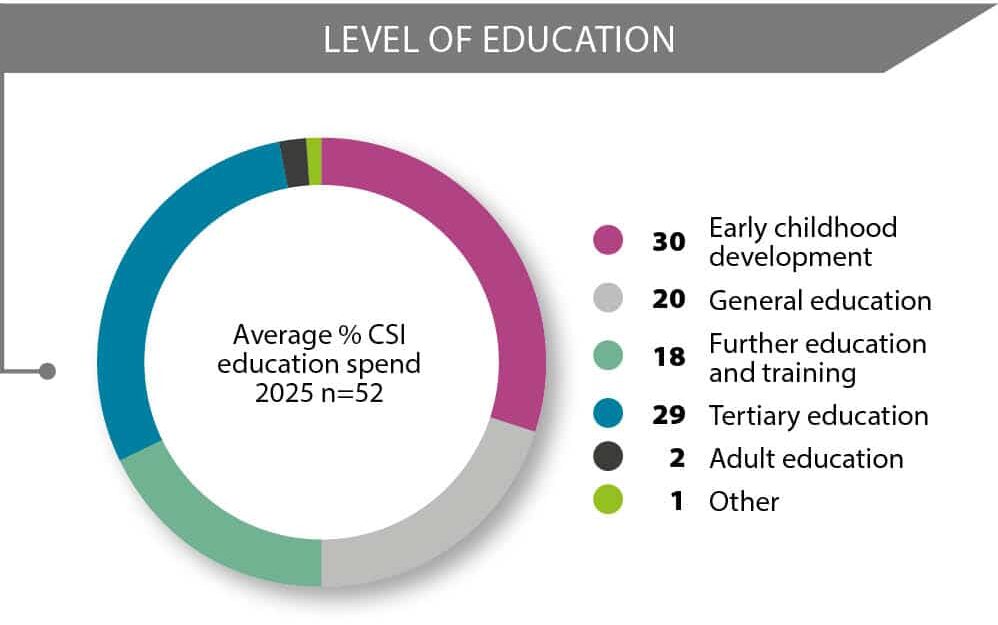
- Early childhood development (ECD) accounted for nearly a third (30%) of education spend on average, similar to 2024 (31%).
- Average expenditure on school-level education (general education plus further education and training) decreased slightly from 42% in 2024 to 38% in 2025.
- Tertiary education received an average of 29% of education spend, an increase from 23% in 2024 and 27% in 2023.
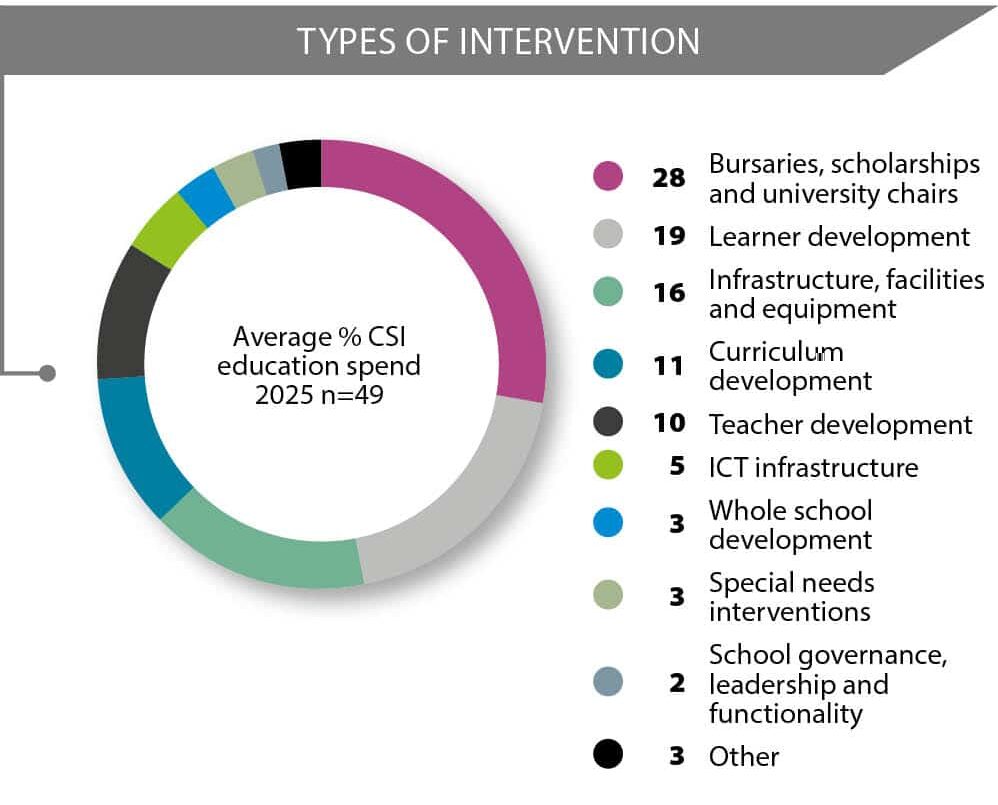
- Bursaries, scholarships and university chairs remained the most supported intervention type in the education sector, with average CSI education expenditure increasing slightly from 24% in 2024 to 28% in 2025.
- Learner development received the next highest average spend at 19%, almost double the 10% recorded in 2024.
- Infrastructure accounted for 16% of average CSI education spend, consistent with 2024.
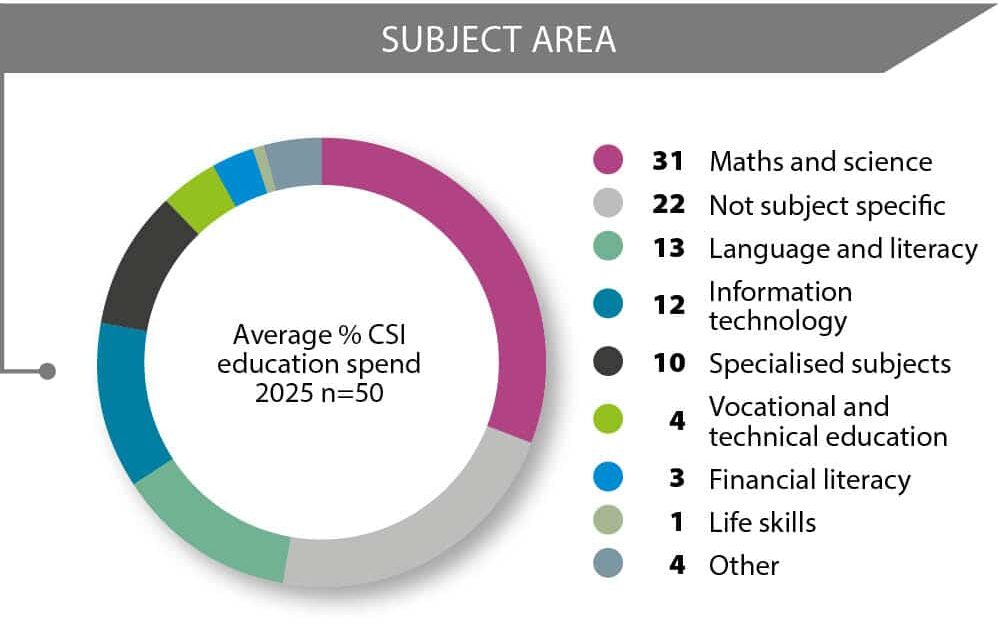
- On average, companies allocated the highest percentage of their CSI education budgets (31%) to maths and science, up from 24% in 2024. Maths and science returned to being the most funded subjects, consistent with survey results for more than a decade, except for 2023 when non-subject-specific funding topped the list.
- About a fifth of CSI education expenditure (22%) was not subject specific in 2025, compared with higher proportions in previous years (38% in 2024).
- Consistent with survey findings over the past two years, companies spent 13% of their CSI education budgets on language and literacy in 2025.
- There was a slight increase in funding for information technology from 7% of average CSI education spend in 2024 to 12% in 2025.
- Vocational and technical education (4%), financial literacy (3%) and life skills (1%) continued to receive the smallest share of average CSI education spend.
Read more:
- Read the case study data dashboard drives education transformation.
- Source: The original version of this article was published in the Trialogue Business in Society Handbook 2025 (28th edition).
